Investment Advisor Platform — XP Investimentos
Product Design • UX Consulting • UX Research • Information Architecture • B2B • Platform • Fintech
XP INVESTIMENTOS (VIA INSITUM) · LEAD / SENIOR PRODUCT DESIGNER
Rede is a SaaS tool that enhances investment advisors' efficiency, offering comprehensive investment overviews and optimized workflows. The platform's scalability contributed to a 367% increase in advisors connected to XP's ecosystem, transforming their work experience.
The Context
Rede is a powerful working platform for investment advisors. This SaaS tool addresses the challenge of managing client investments efficiently and flexibly, offering an overview of investments, risk profiles for each investor, and a product showcase.
As a Product Designer in this project, I had the privilege of working closely with Gabriel Leal, VP of Marketing and Customer Success, product managers, investment advisors, and the head of technology. This collaborative effort was instrumental in shaping the platform to meet the unique needs of investment advisors, making them feel valued and integral to our success.
Summary
Rede is a dynamic SaaS platform for investment advisors, designed through collaboration with experts to manage client investments efficiently, offering comprehensive overviews and risk profiles, ensuring advisors feel valued and integral to its success.
The Challenge
Redesign the working platform for XP's investment advisors and partner offices, unifying products and systems that had been completely siloed into one coherent experience.
My Role
I worked as UX Consultant on the INSITUM team — with direct involvement in field research, structuring the ecosystem, prototyping and validating the experience with real users.
My Approach
Adopting a user-centric approach, I employed the shadowing research technique to observe users closely. This allowed me to identify recurring task patterns, which I later discussed with users to gain deeper insights into their tasks.
I started planning how am I going to address the task it was assigned to me based on the context of the project and the target audience.
How am I going to deliver an end-to-end solution based on what I know so far and what I don't know in details yet?
Practical Questions to plan and execute the project framework
- Who are the users exactly?
- What are the user's goals?
- What are the tools used by Investment Advisors?
- How do they recommend investment assets to their customers?
- What are the user's pains with the current platform?
- What are the daily friction points using the current platform?
- What are the tasks they spend most of time working on?
- What are the daily friction points using the current platform?
- How does a typical day of work look like?
- How investment advisors track customer's portfolio?
- How investment advisors track suggest new assets for investment?
- What is the Investment Advisor user journey?
Role
The project was structured in three major phases:
• Research and Immersion: watch users in their natural environment.
• Co-Creation and Roadmap: Workshop sessions with advisors, investment specialists and technology team.
• Design Cycles: Prototyping, Design System, Usability testing, Fine tuning for delivery.
Phase 1 — Research and shadowing
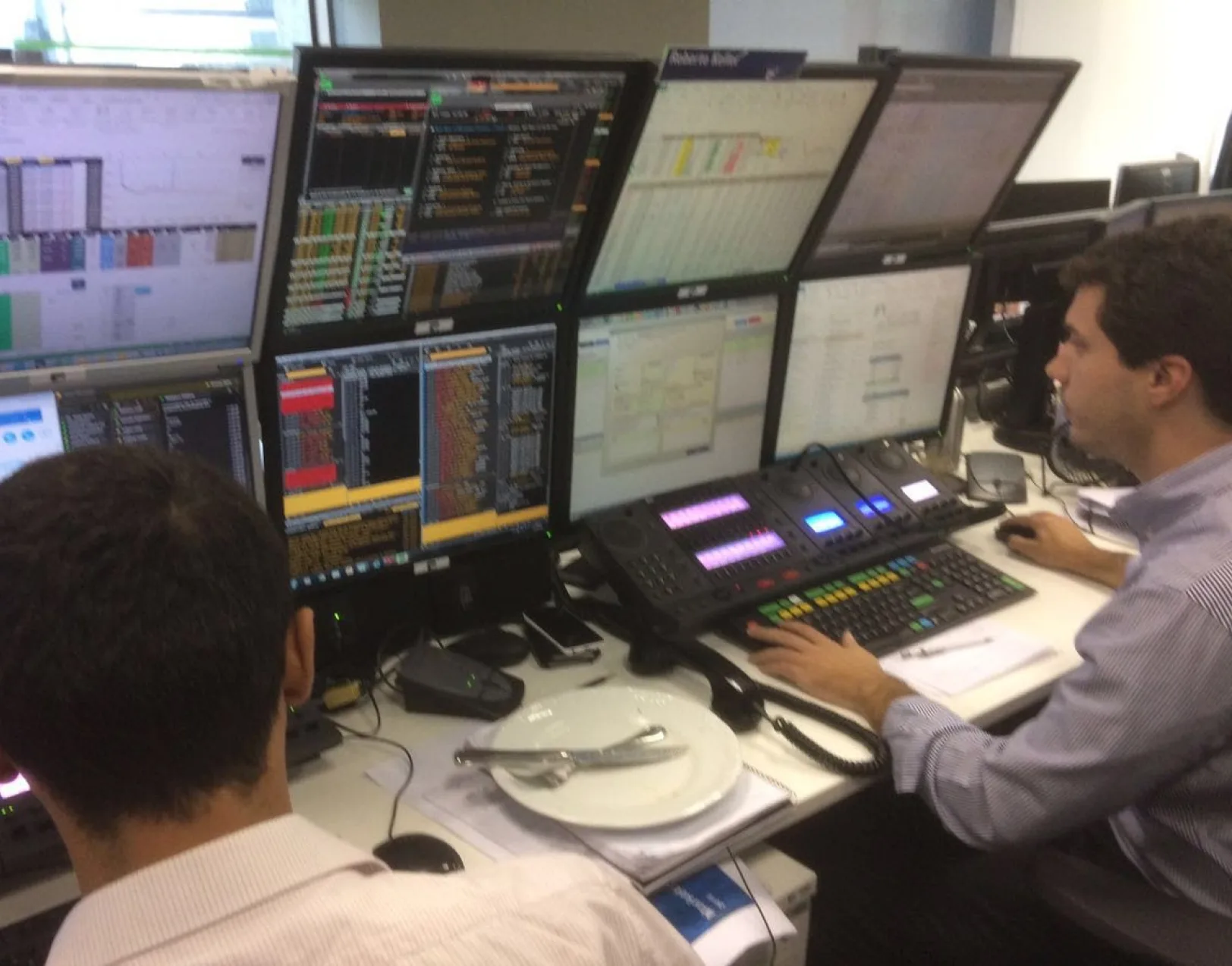
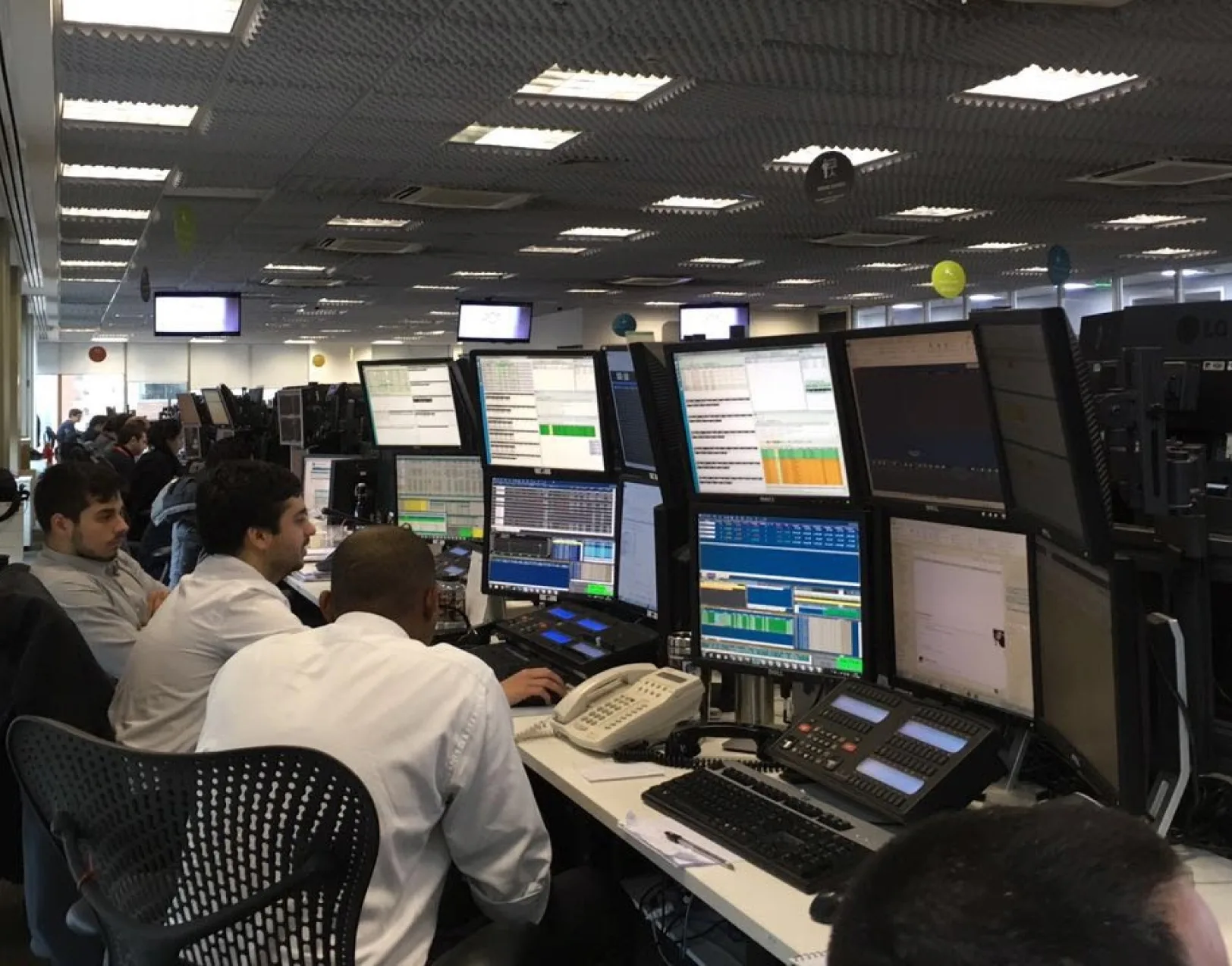
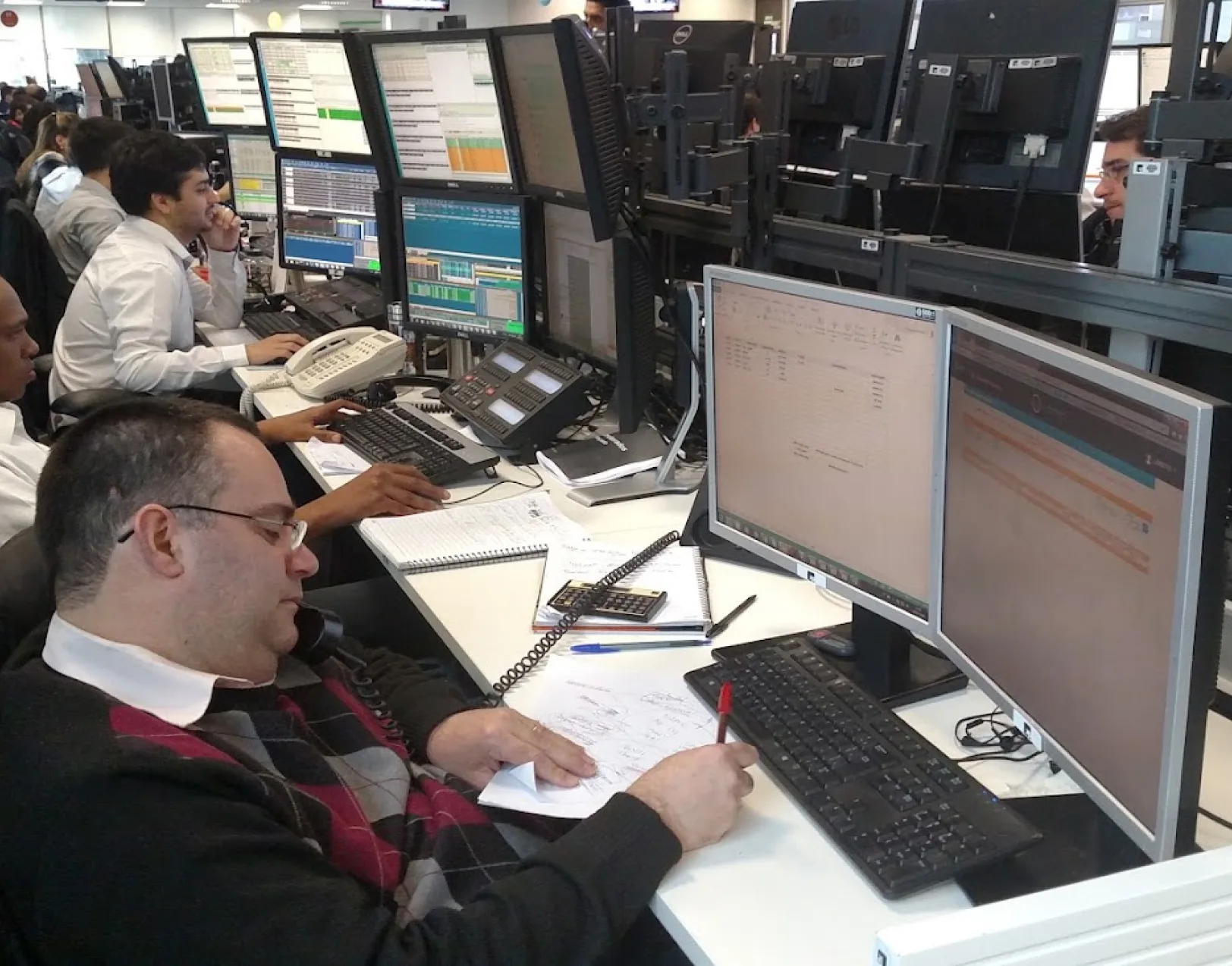
I delved deeply into the work experience of investment advisors and the set of tools they used daily. Many felt mentally exhausted and discouraged by the end of the day due to several friction points with the available tools.
The insights from this research phase helped me develop prototypes for various functionalities to optimize the work of investment advisors.
 1 / 5
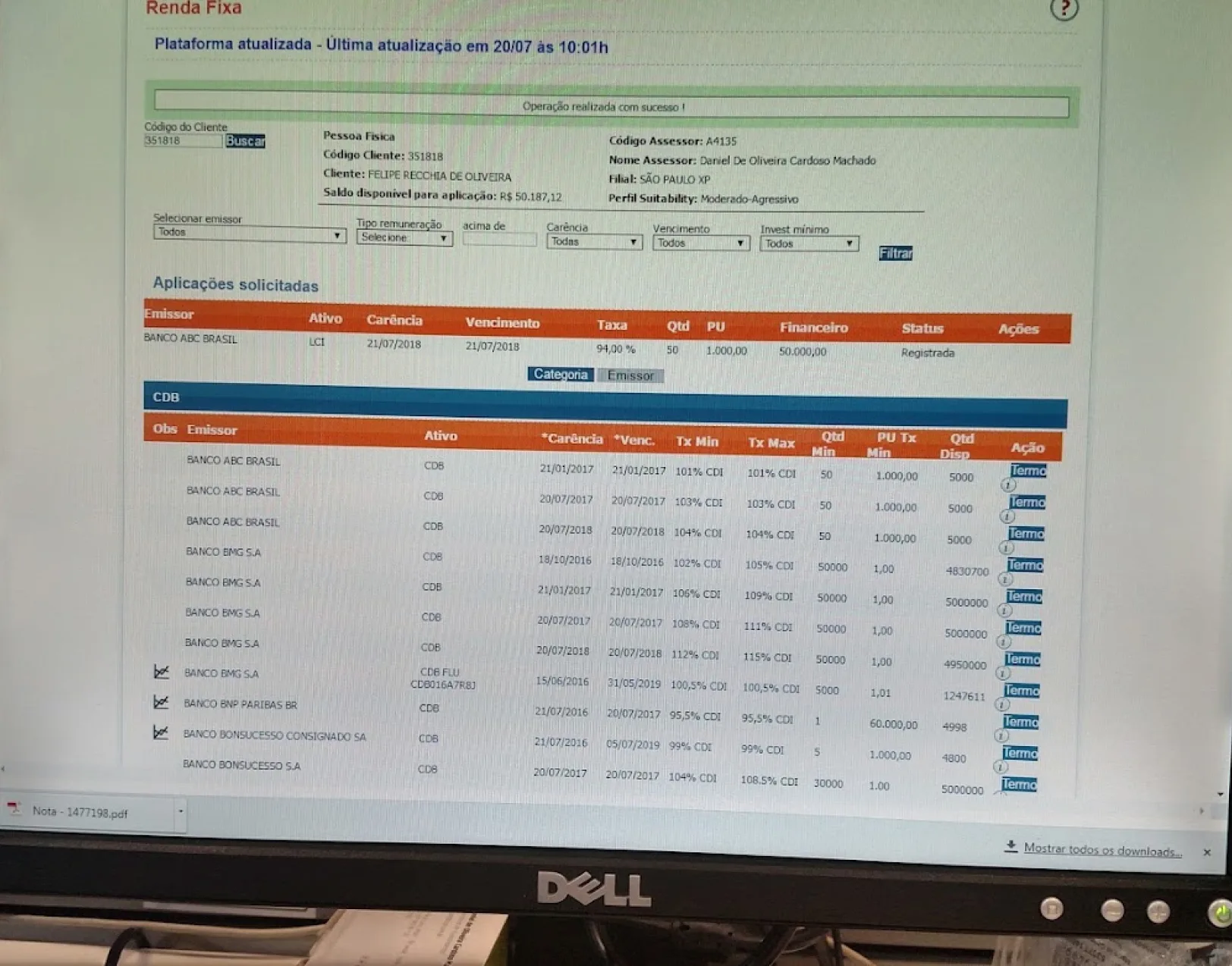
Shadowing with investment advisors and partner offices
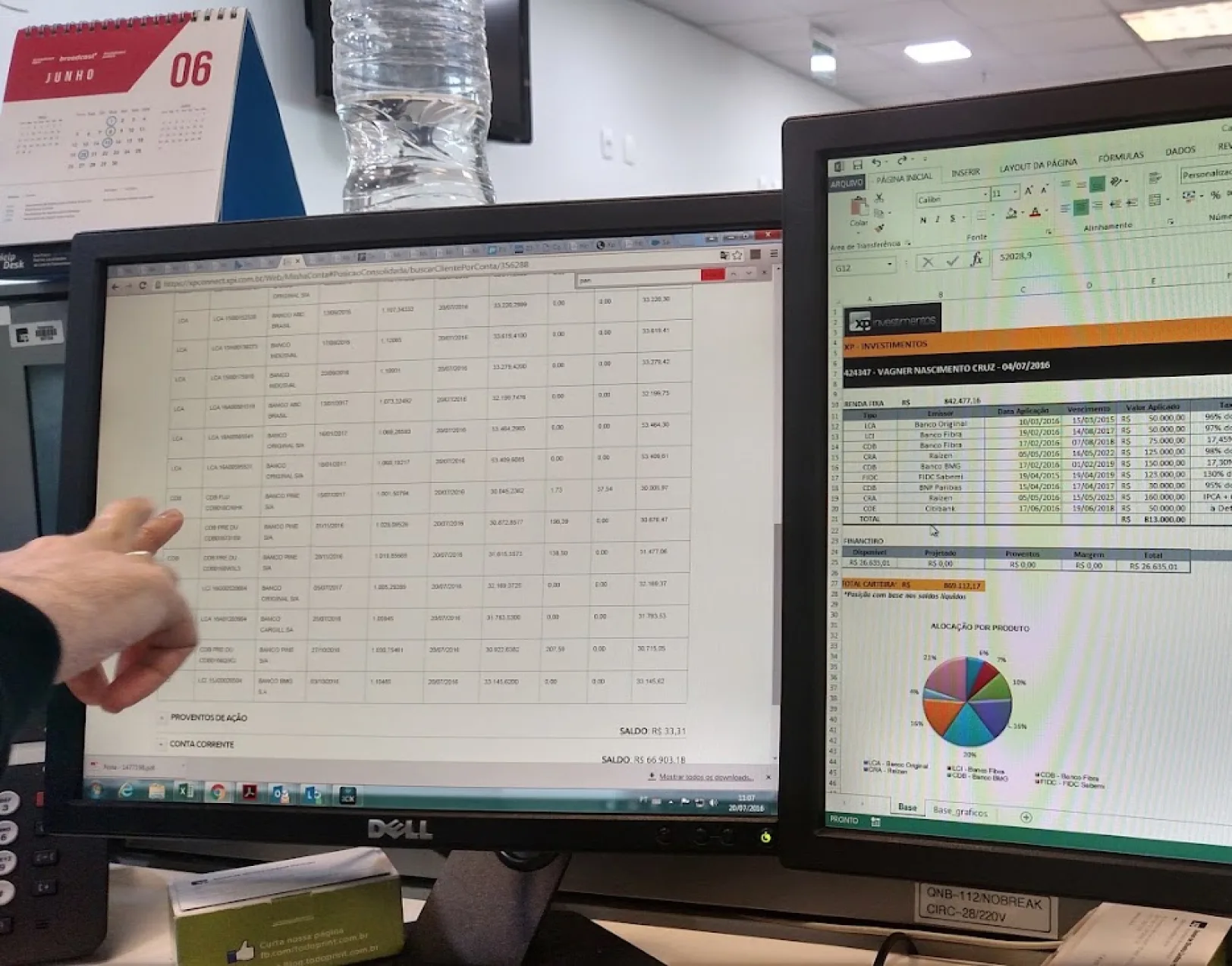
On-site observation of advisors' day-to-day over the course of a week: watching work flows, the tools they used, patterns in complex tasks and the main friction points. In-depth interviews to capture the why behind each behavior.
"I need to work with about five browser tabs for each client. I also work with at least 20 clients at the same time. I need to gather my clients' asset information, consolidate it into an Excel file, and present it to them. I spend the entire day opening and closing different systems to consolidate this information. This job is not for beginners."
— Investment Advisor
"It's very laborious to track the settlement date of my client's fixed-income assets. If the asset is settled/redempted and the money sits idle in the investment account, I must invest that capital as soon as possible. I must ensure clients' money doesn't sit idle without yielding earnings. If my manager discovers I left money idle, he will think I'm not doing my job properly."
— Investment Advisor
Mapping real work flows
To understand the investment advisor's experience, I conducted shadowing sessions keeping track how they ran workflows, tracking client investments, researching potential investments, and having communications with clients.
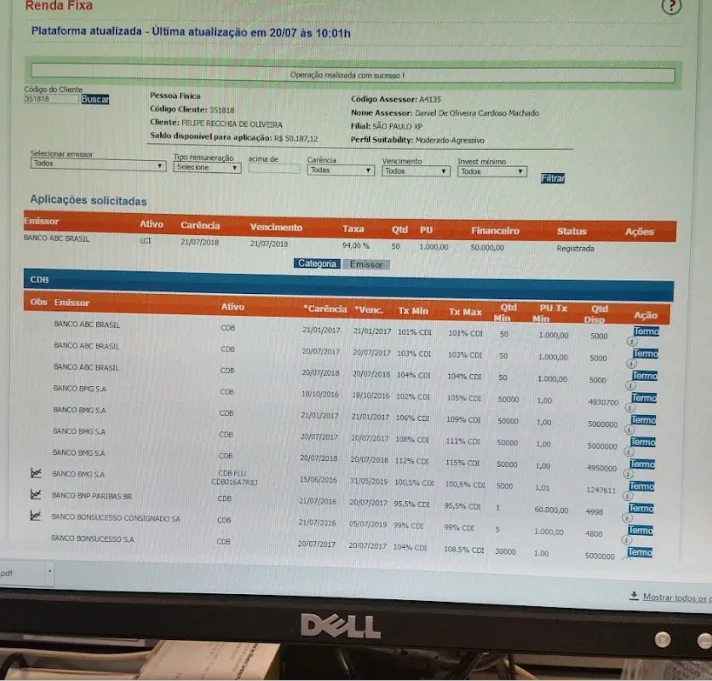
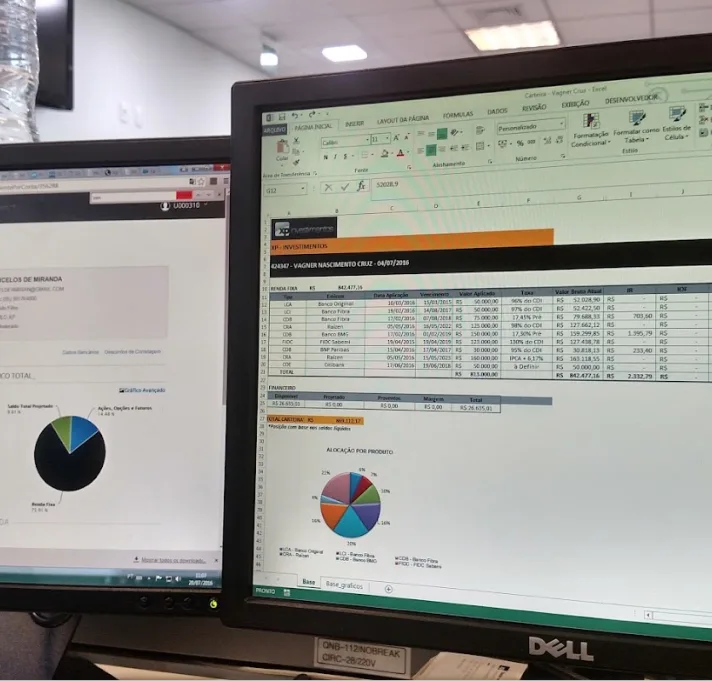
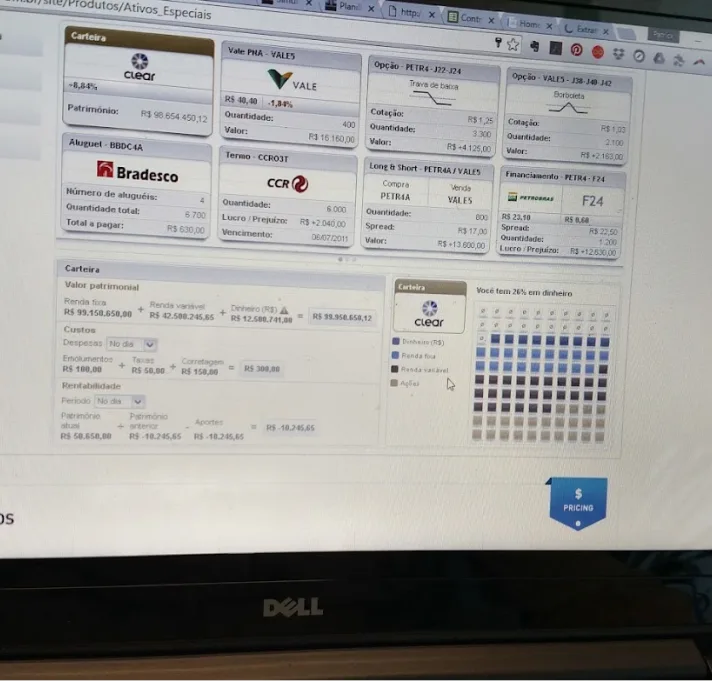
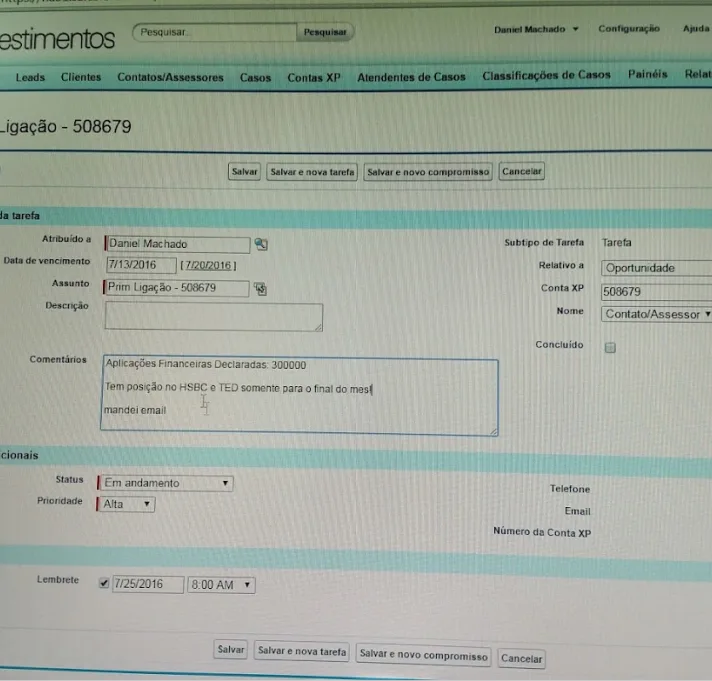
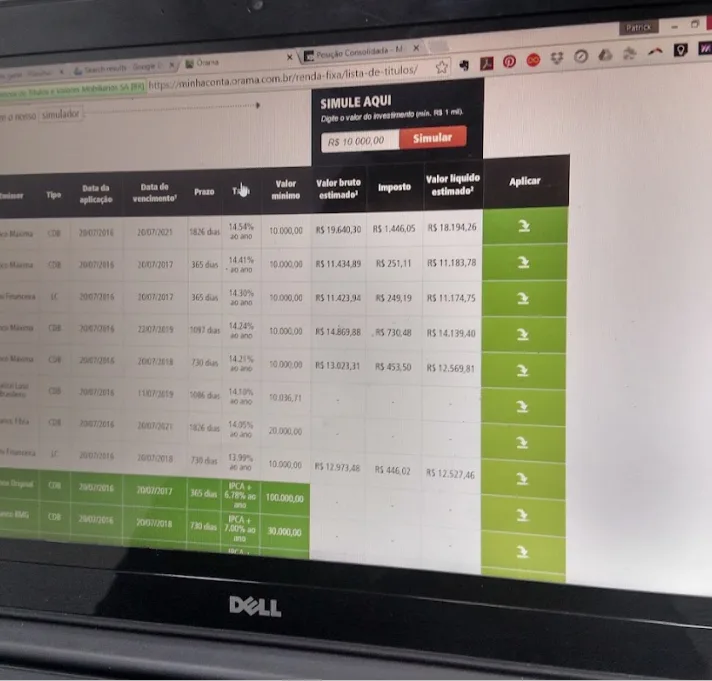
I learned how they monitored their clients' assets, chose new assets for investment, communicated with them, and suggested investing available capital in new investment products according to each client's risk profile.
I witnessed how this work was arduous and mentally exhausting due to the inefficient system navigation. I documented all these interactions with audio, photos, and videos.
This phase was essential for understanding the workflow and identifying tasks that caused a painful work experience. Identifying the moments that created friction points with the old platform, unmet needs, and improvement opportunities was very easy.
Learnings from Field Work
- I learned how they monitored their clients' assets,
- chose new assets for investment, communicated with them
- User's work was arduous and mentally exhausting due to the inefficient system navigation.
- Navigation has no information architecture: pages are isolated data queries.
- The daily work of investment advisor is fragmented, slow and error-prone.
- To carry out a simple operation, an advisor had to switch between dozens of tabs and siloed systems
- Each system requires users to retype the client's ID from scratch.
- Company ran products across disconnected and rudimentary systems.
- Current platform structure is holding business to scale.
- Users carry a heavy cognitive load, filling the gaps left by disconnected systems.
- Navigation is buried in a floating menu with 100+ items.
- Navigation has no information architecture: pages are isolated data queries.
- Users have to re-enter the customer ID for every query.
- Investment tools are isolated, with no workflow connecting them.
- System pages look like database forms.
- The platform has a steep learning curve.
Learnings summary
The central challenge was to condense a tree of more than 100 navigation items into a simple platform, logical and contextual, without losing the operational complexity the investment business demands. The solution needed to be modular so it could scale by product area gradually.
Phase 2 — Ecosystem and co-creation
The previous phase was essential for understanding the workflow and identifying tasks that caused a painful work experience. Identifying the moments that created friction points with the old platform, unmet needs, and improvement opportunities was very easy.
I fostered a collaborative environment by conducting co-creation sessions with key stakeholders and partner office owners. Their valuable insights and contributions were instrumental in validating the concepts of new features, a new navigation model and new financial asset investment reports for clients.
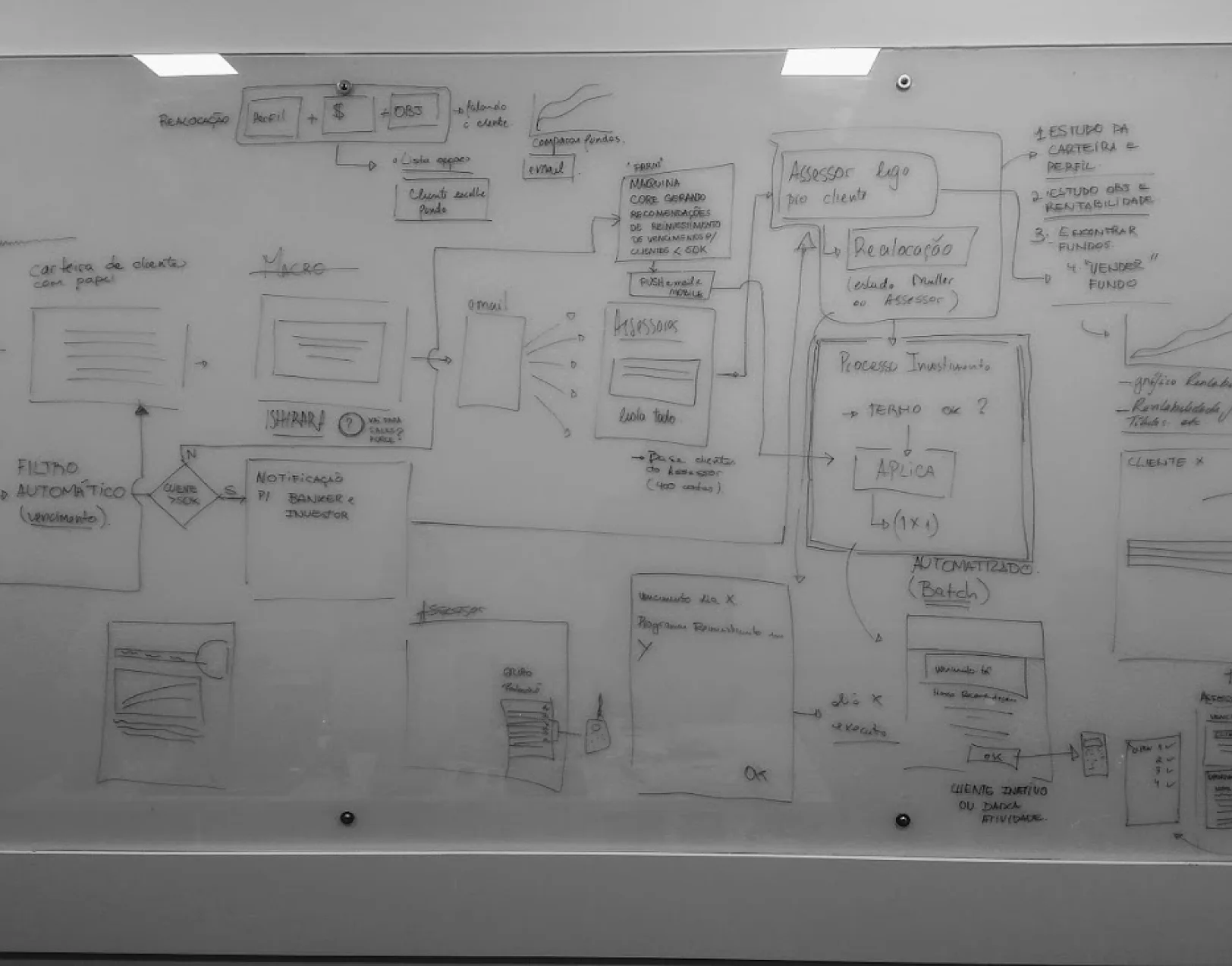
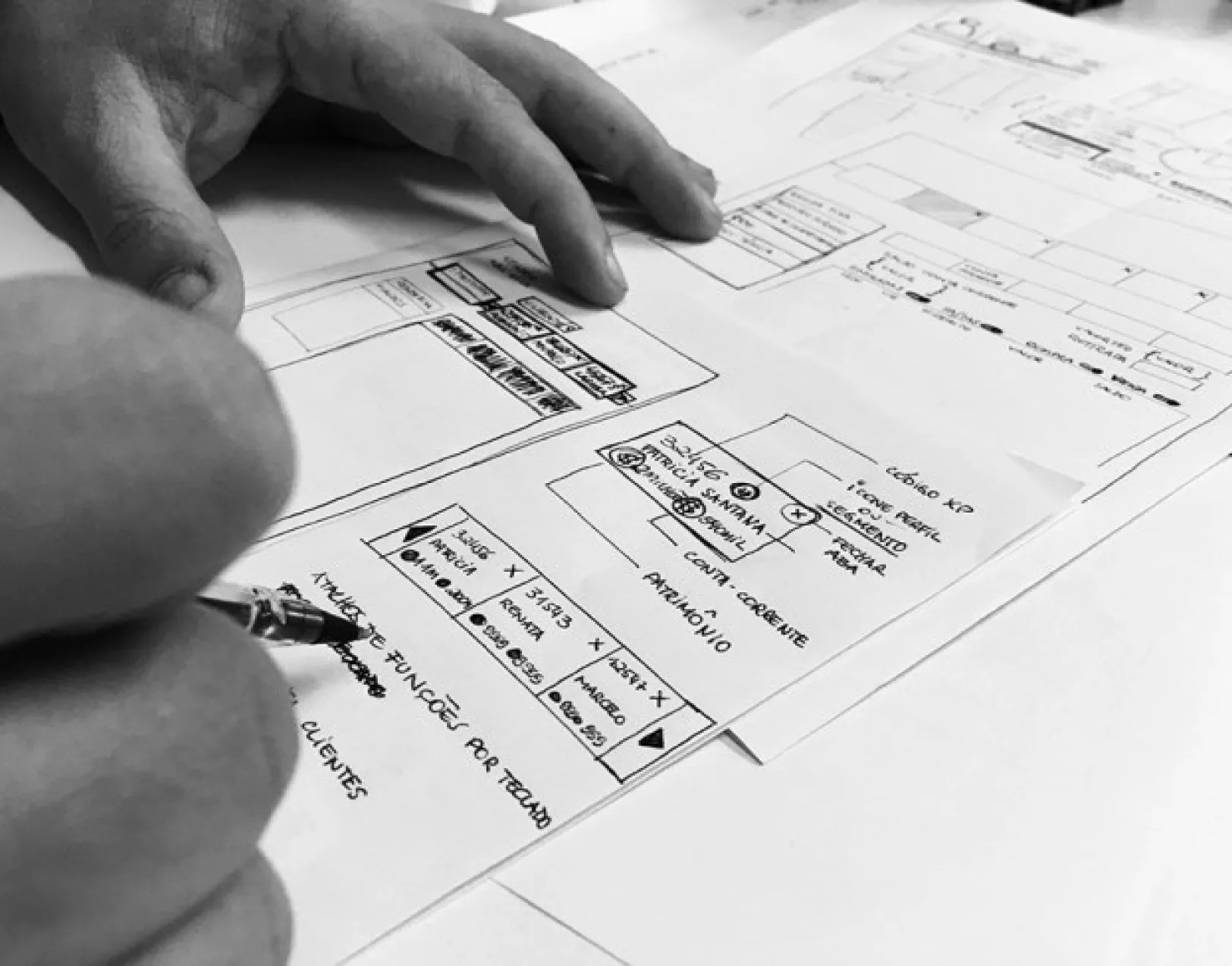
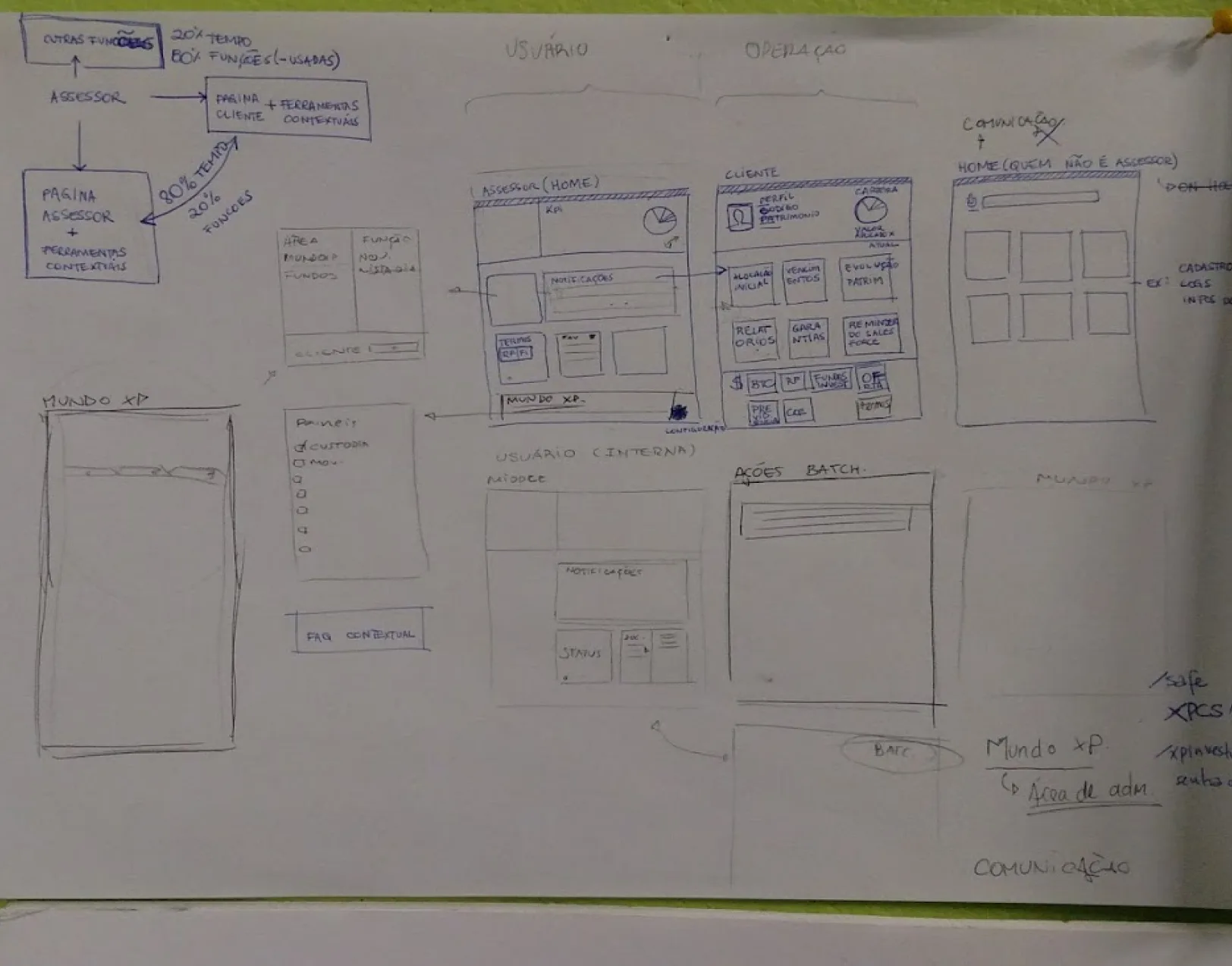
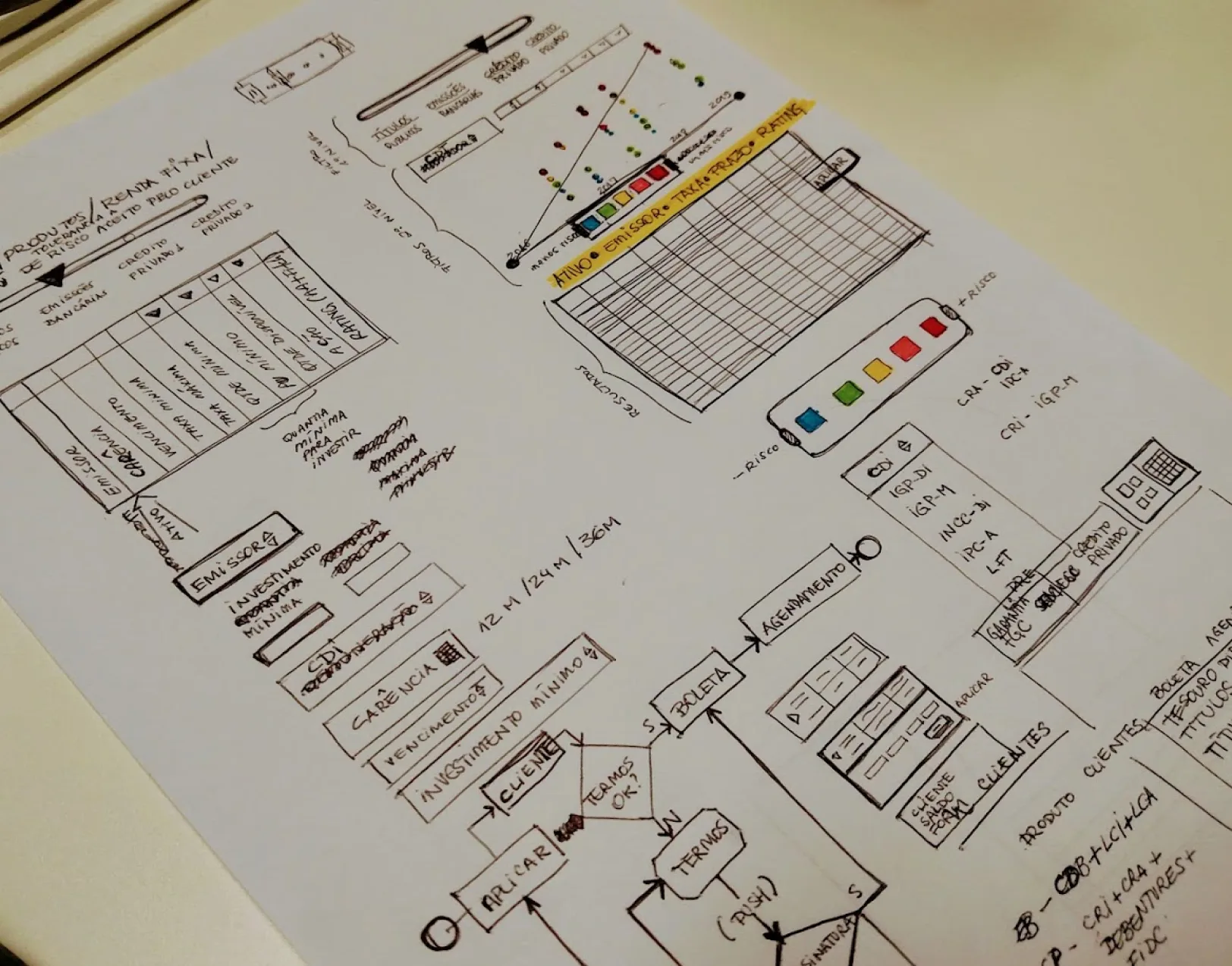
Co-creation sessions with advisors, investment specialists and technology teams to structure the new platform's ecosystem. Defining the information architecture, global navigation, modules and connections between the different financial products. Sketches of the new navigation flows and low-fidelity prototypes in Axure RP.
Then, I created low-fidelity visual prototypes with high interaction fidelity.
 1 / 4
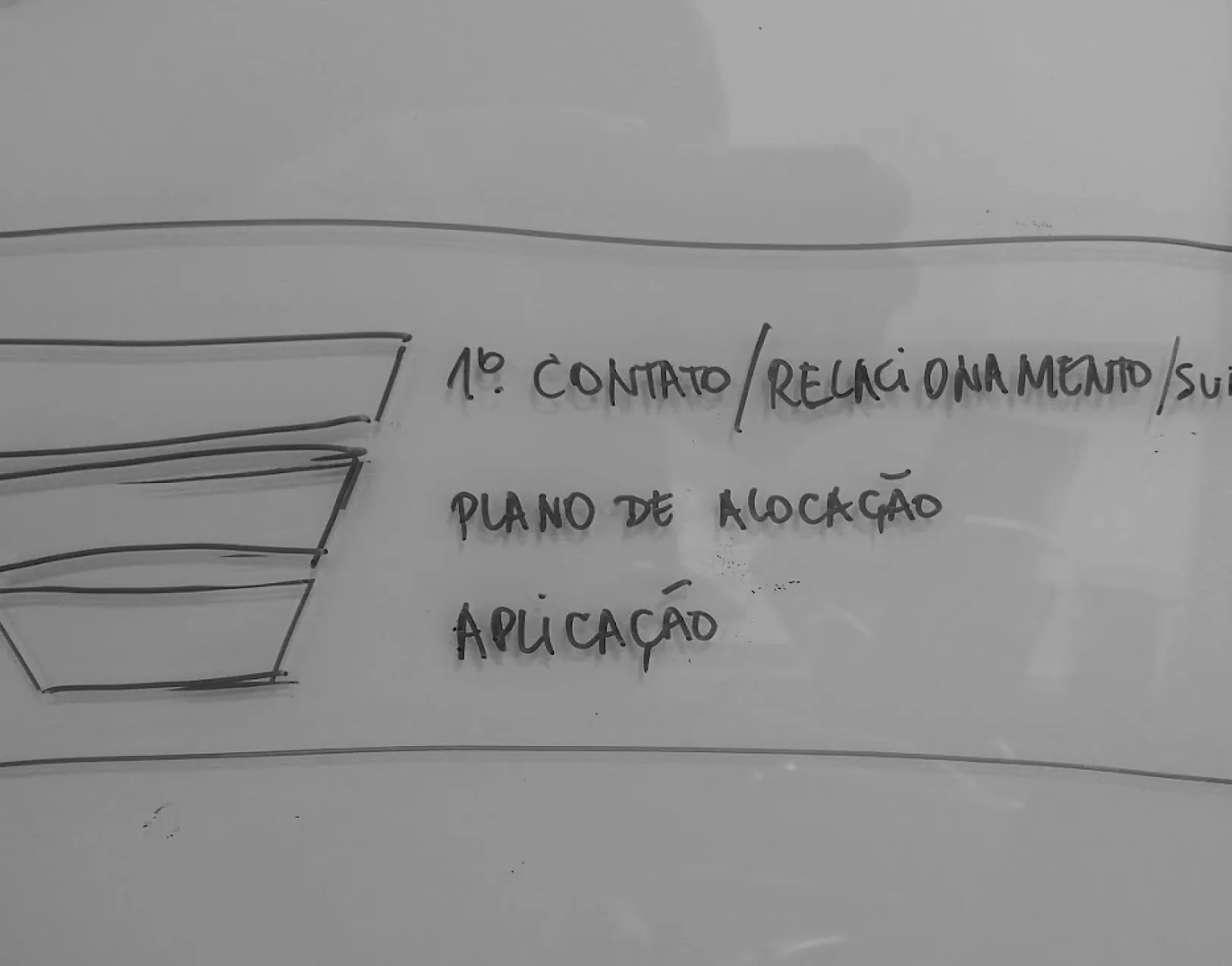
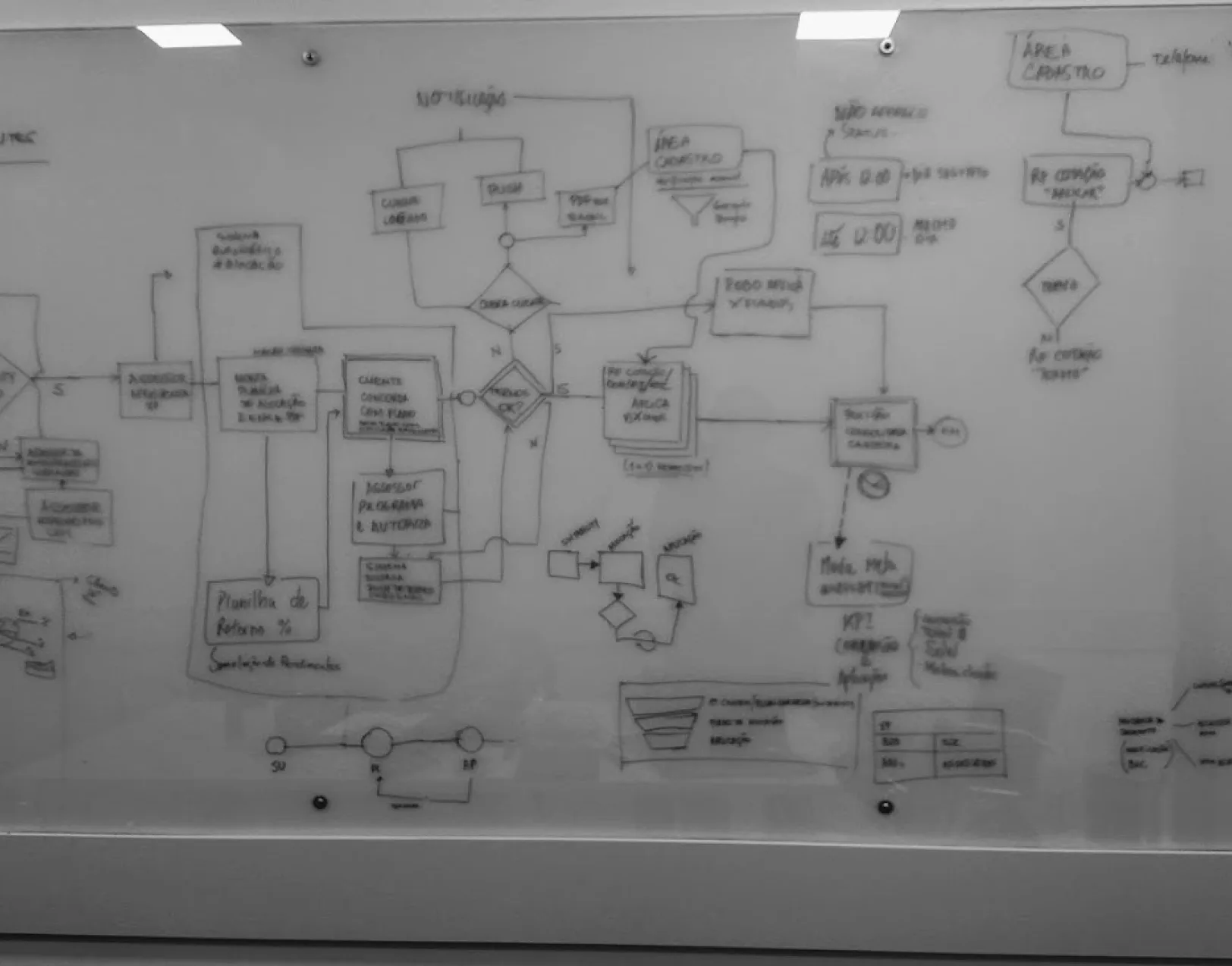
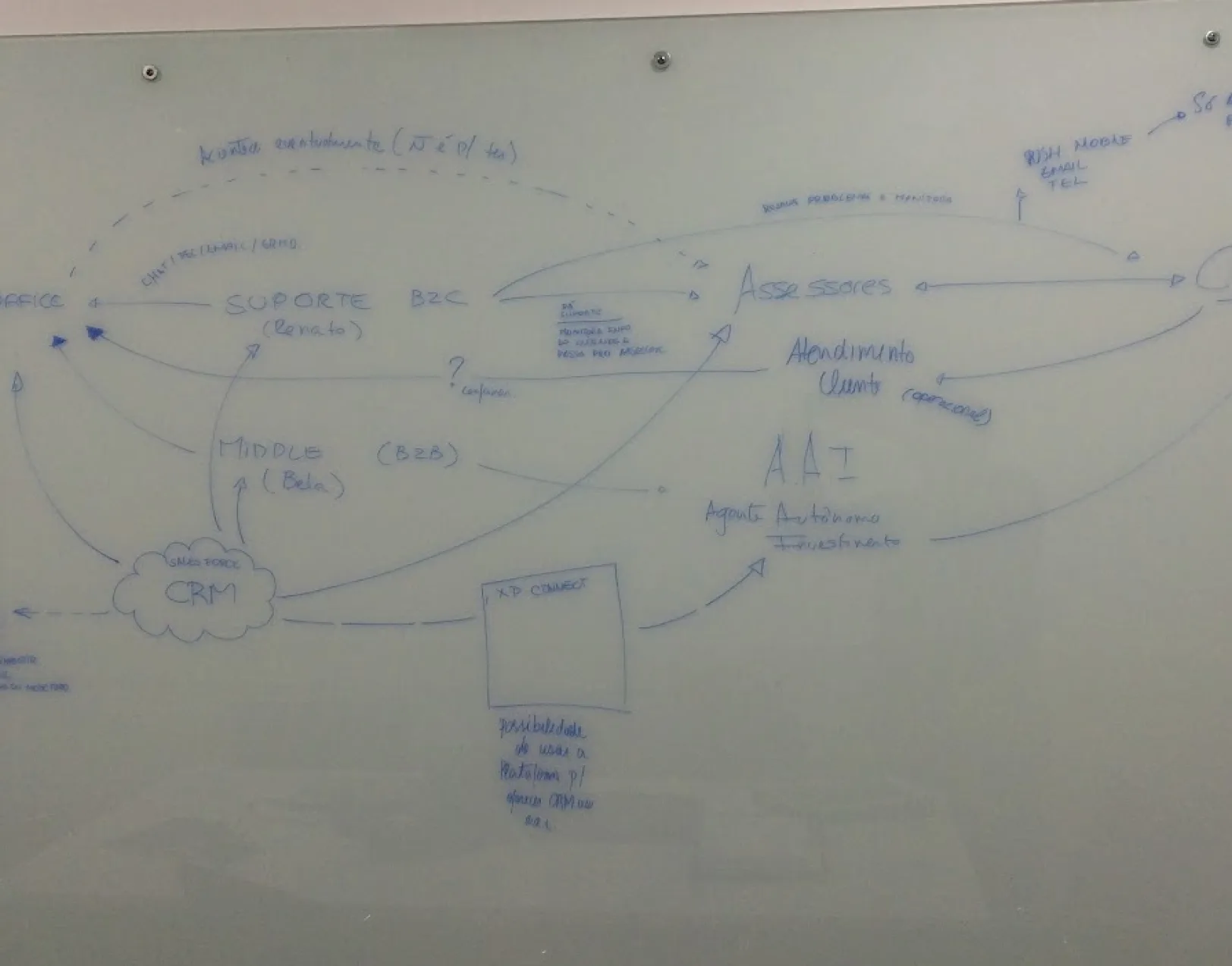
Brainstorming and Co-creation sessions with advisors and technology specialists
With the friction points mapped, I ran brainstorming and co-creation sessions with advisors, partner-office owners and XP's technology specialists. Together we prioritized the most painful tasks — consolidating client positions, tracking maturities and searching for products — and sketched solutions on the whiteboard that became the first low-fidelity prototypes.
The insights from research and co-creation phases helped me develop prototypes for various functionalities to optimize the work of investment advisors. At the end of the prototyping process, we booke validation sessions through usability tests with investment advisors and partner investment firm owners from XP Inc.
Phase 3 — Design cycles and validation
Working in cycles with XP's product areas: prototyping, detailing layouts and usability testing with different advisor profiles — including partner-office owners — to validate the new navigation model and the critical flows.
 1 / 4
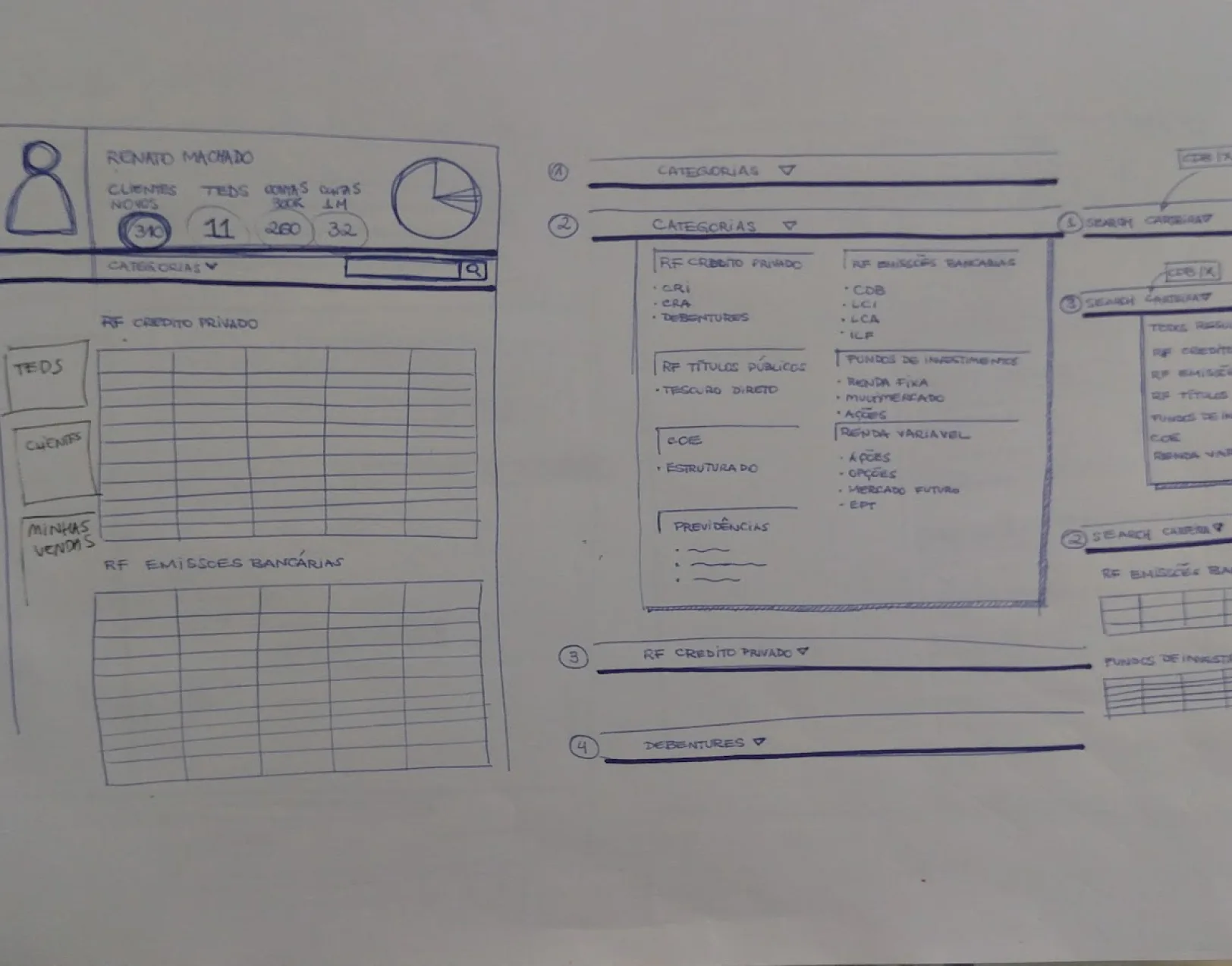
Defining the information architecture and navigation system
The old platform was a floating menu with 100+ items, where each page was an isolated data query. I mapped the actors and flows, reorganized the content into a site map built around the advisor's goals — clients, products, Mundo XP and indicators — and validated it with wireframes. Tab navigation lets advisors keep several clients open without juggling browser windows.
 1 / 5
Design System
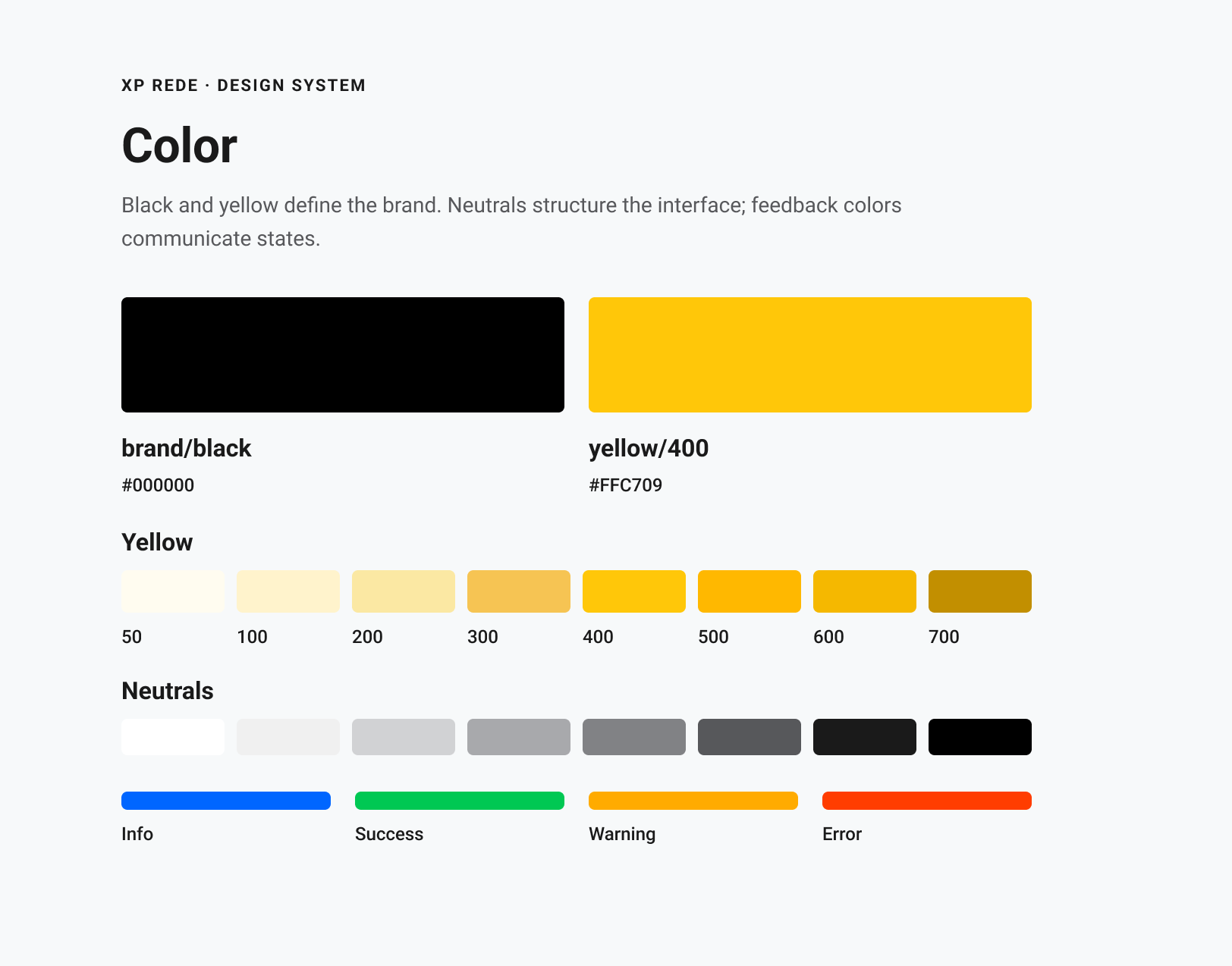
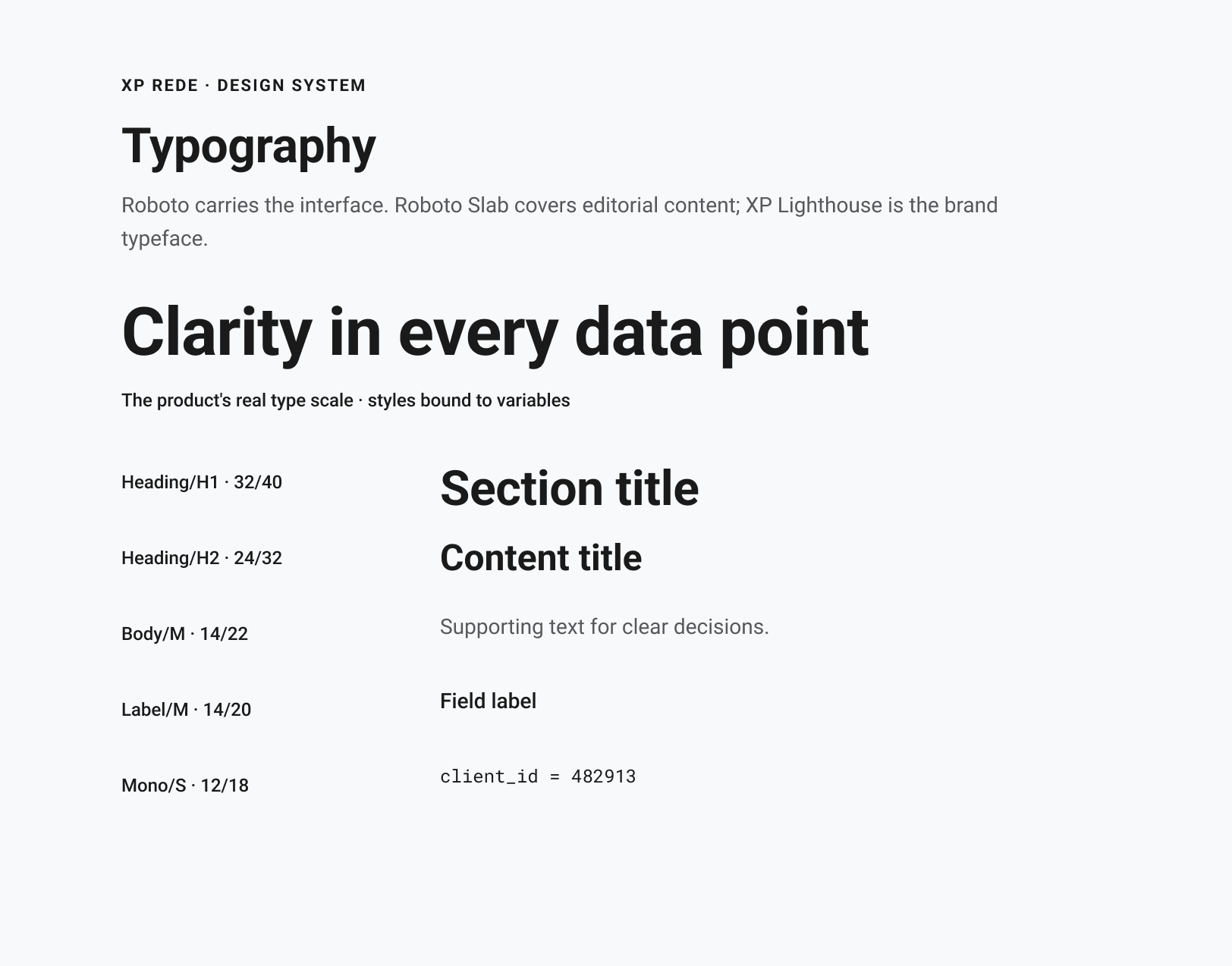
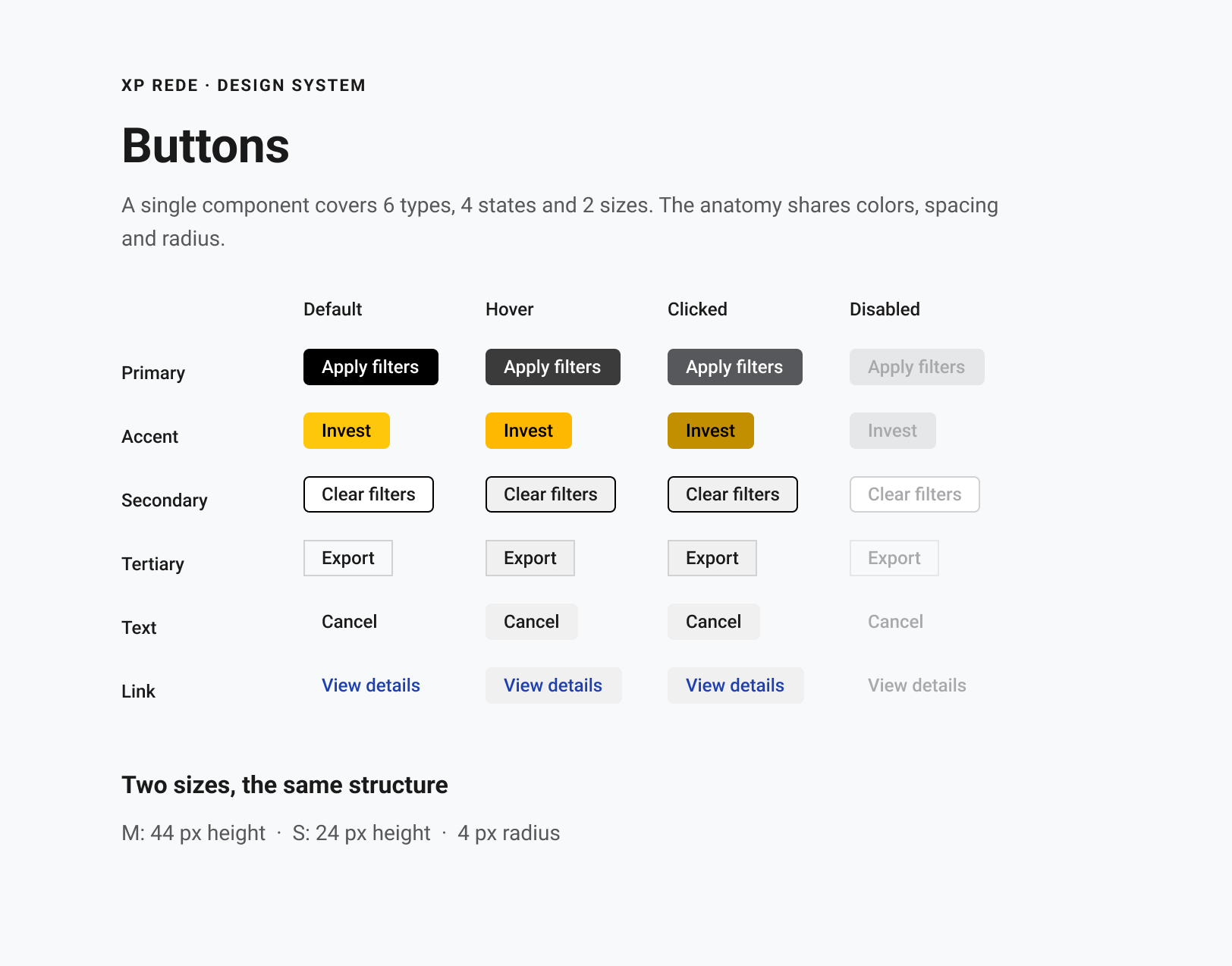
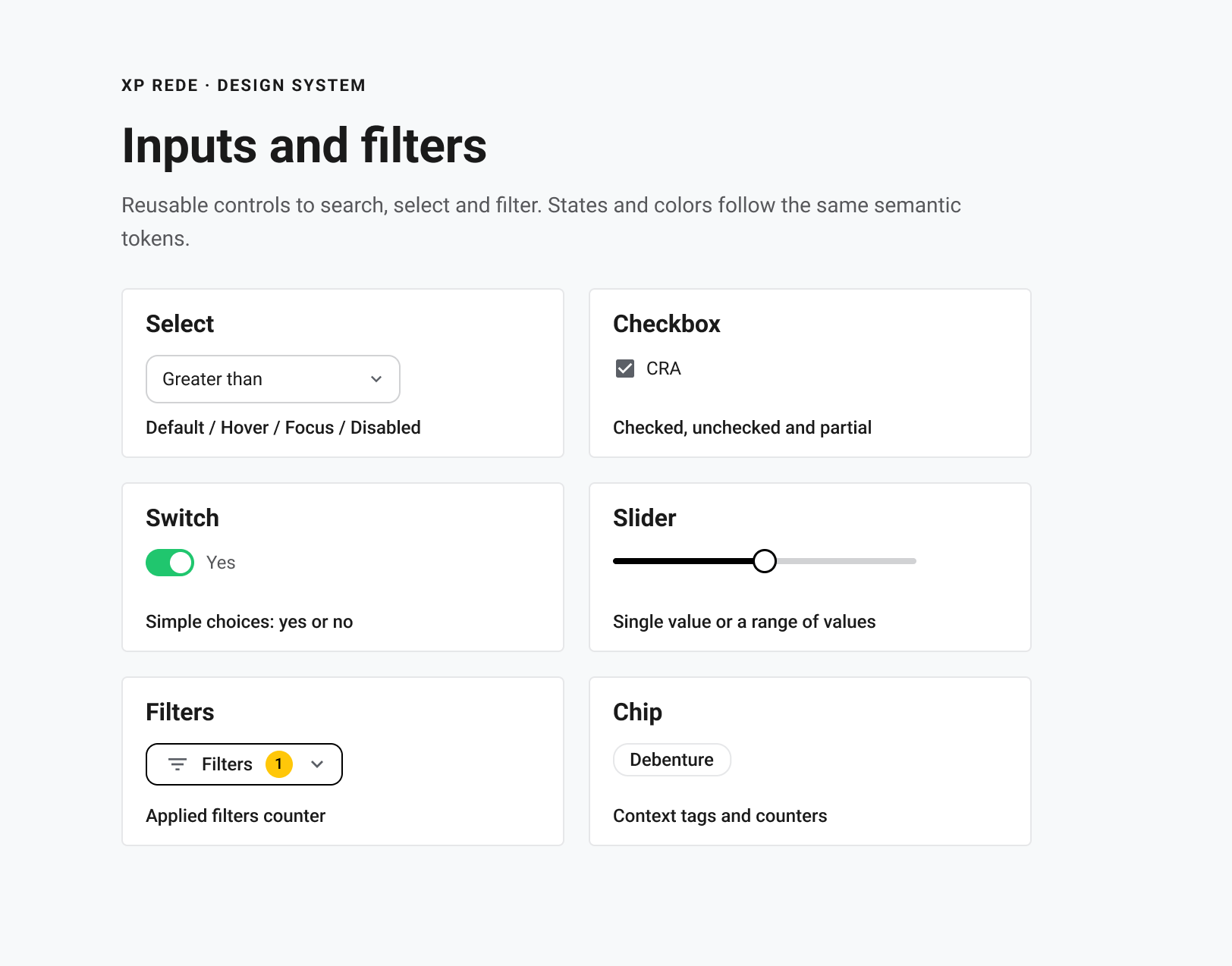
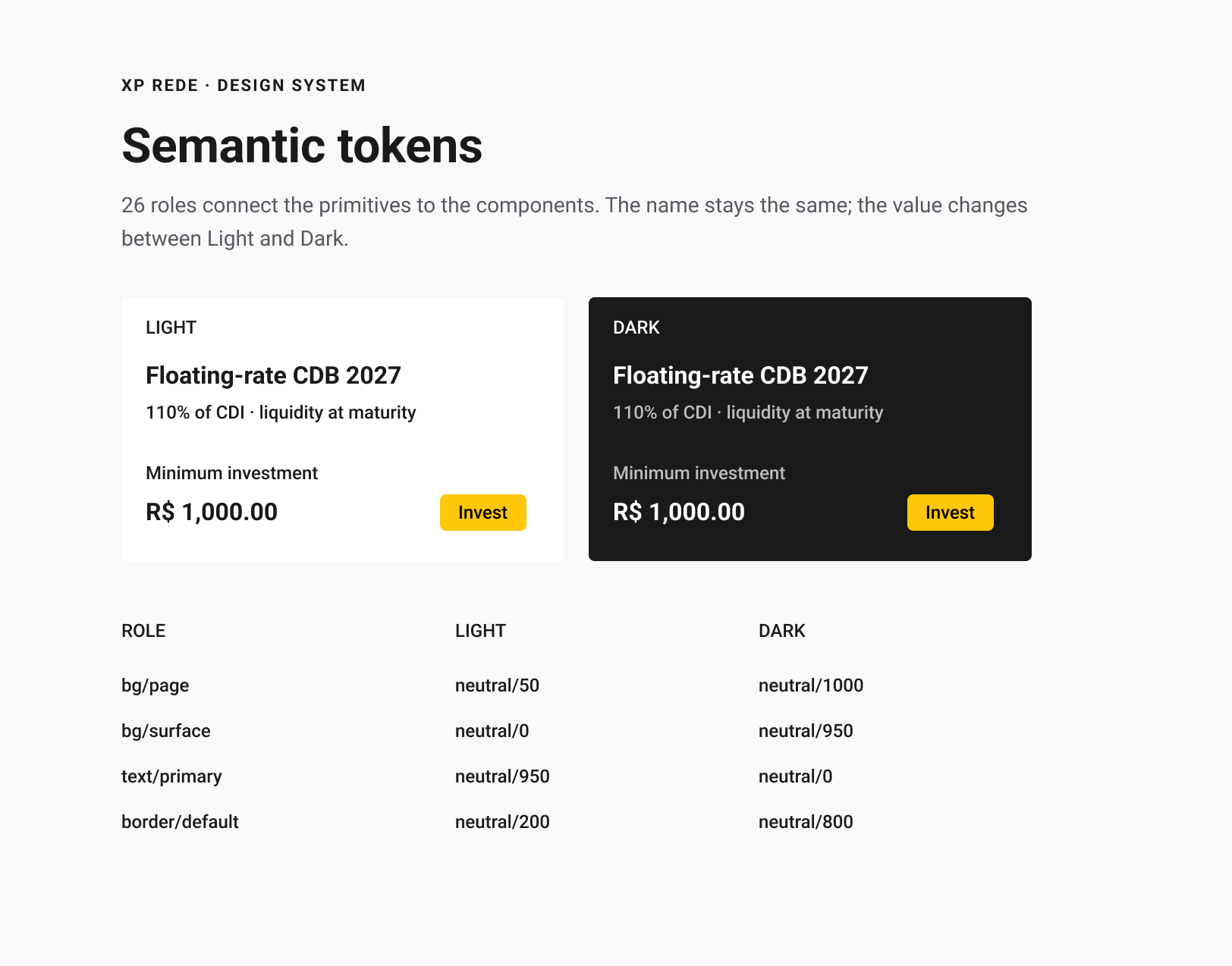
To keep dozens of screens consistent, I built a design system on top of XP's brand: color primitives and 26 semantic tokens with Light and Dark modes, a Roboto type scale, a 4-point spacing grid and components with states — buttons, inputs, filters, chips and tables — reused across every screen.
UI Design
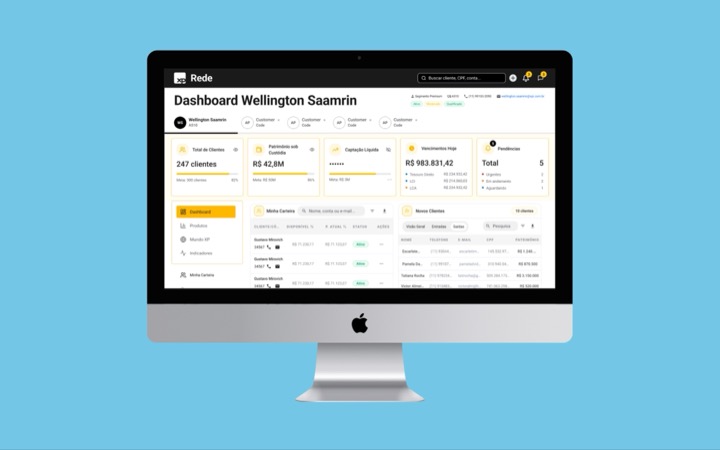
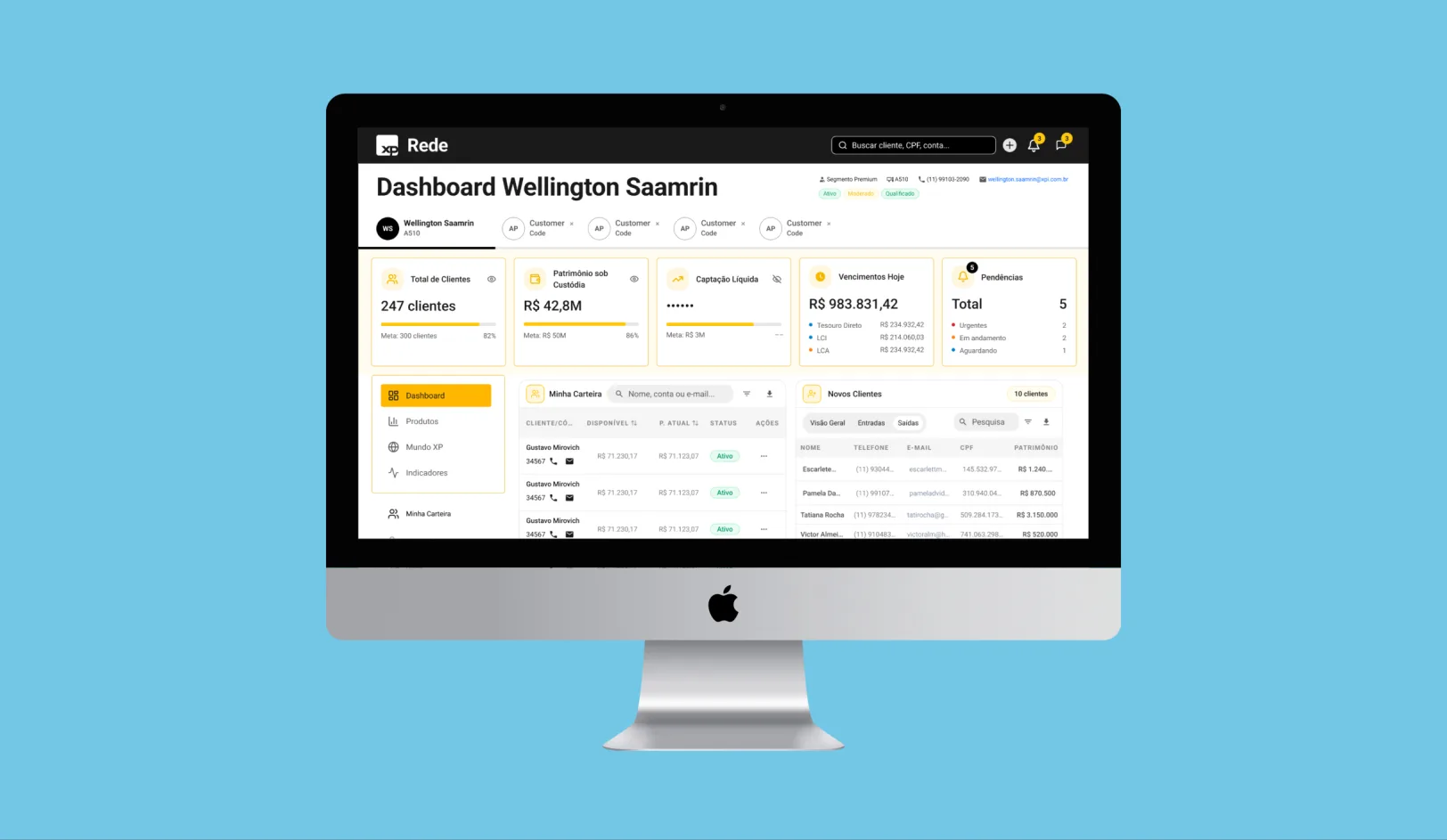
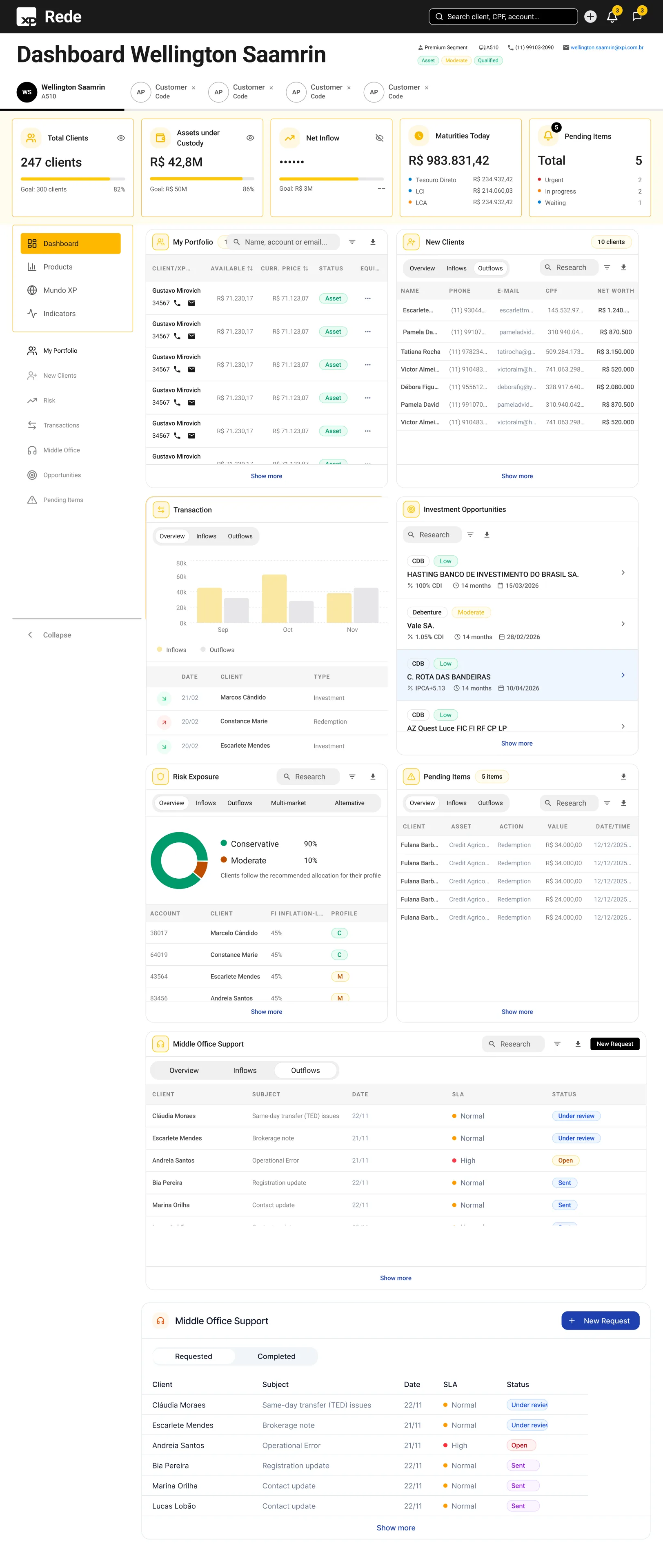
The high-fidelity screens bring everything an advisor needs into one place: a dashboard with clients, transactions and pending items; product catalogs for fixed income, equities and funds, with filters and comparators; Mundo XP for research content; and the client portfolio with consolidated position and investment history.
ADVISOR DASHBOARD
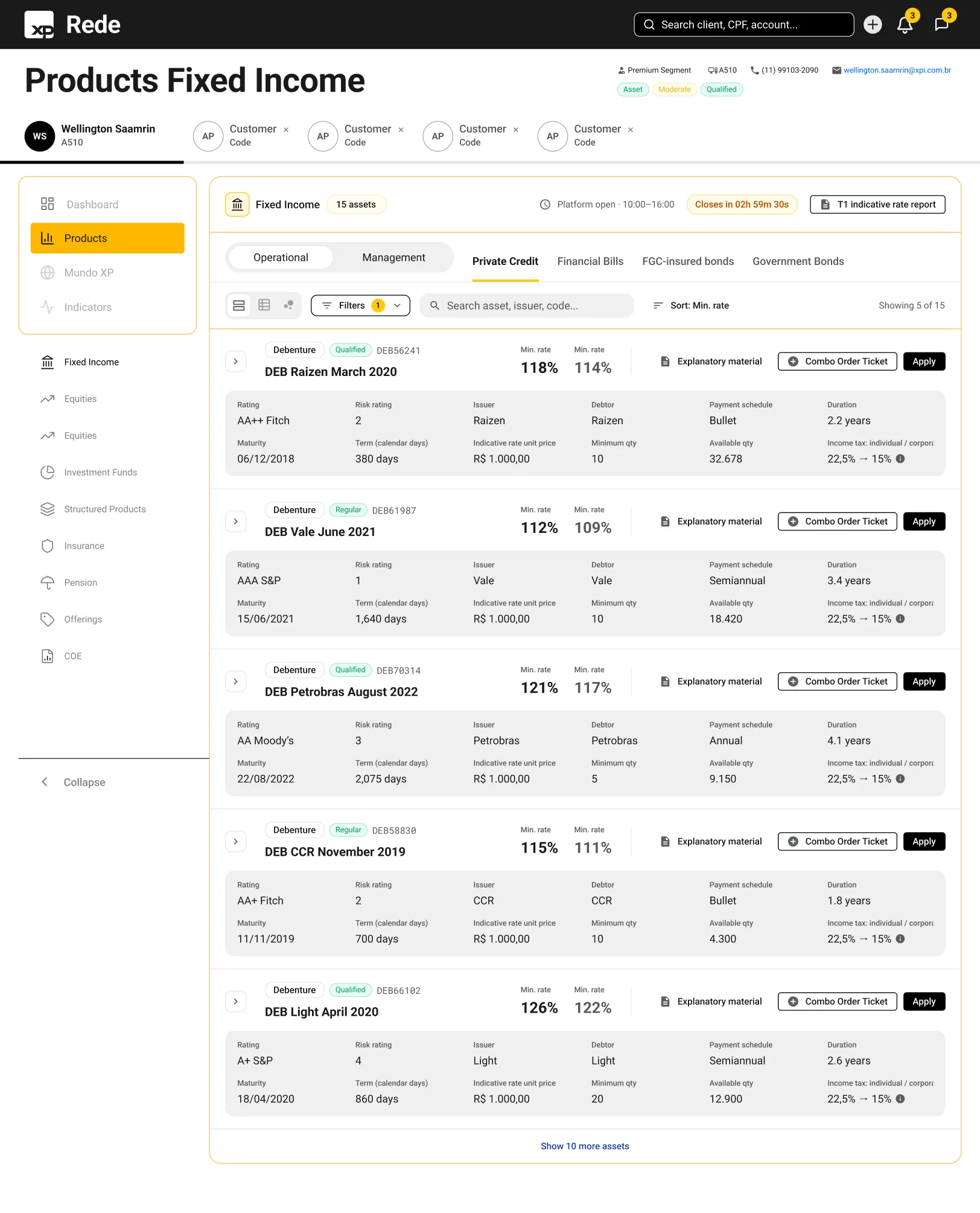
FIXED INCOME PRODUCTS — OPERATIONAL VIEW
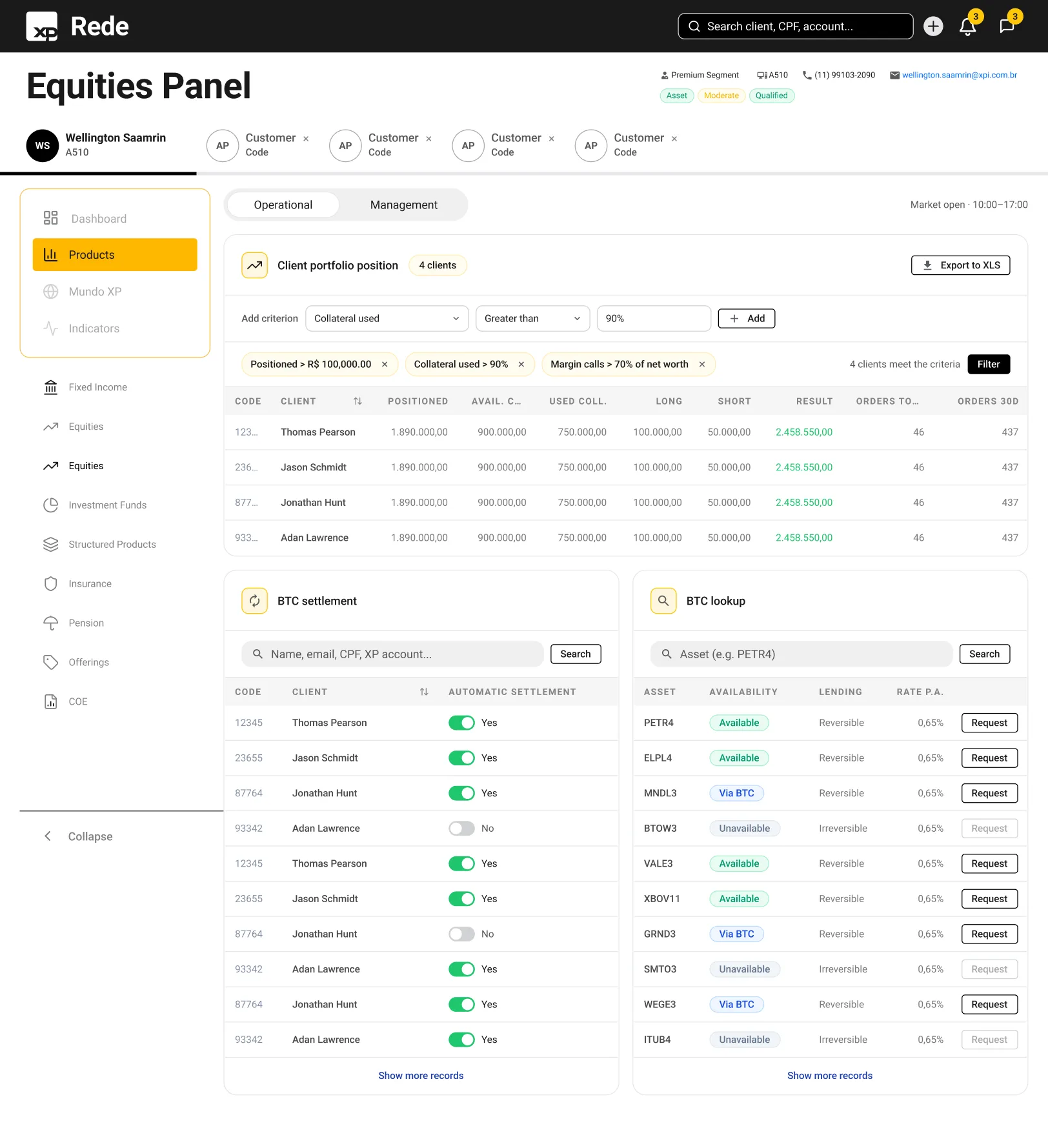
EQUITIES PRODUCTS — OPERATIONAL VIEW
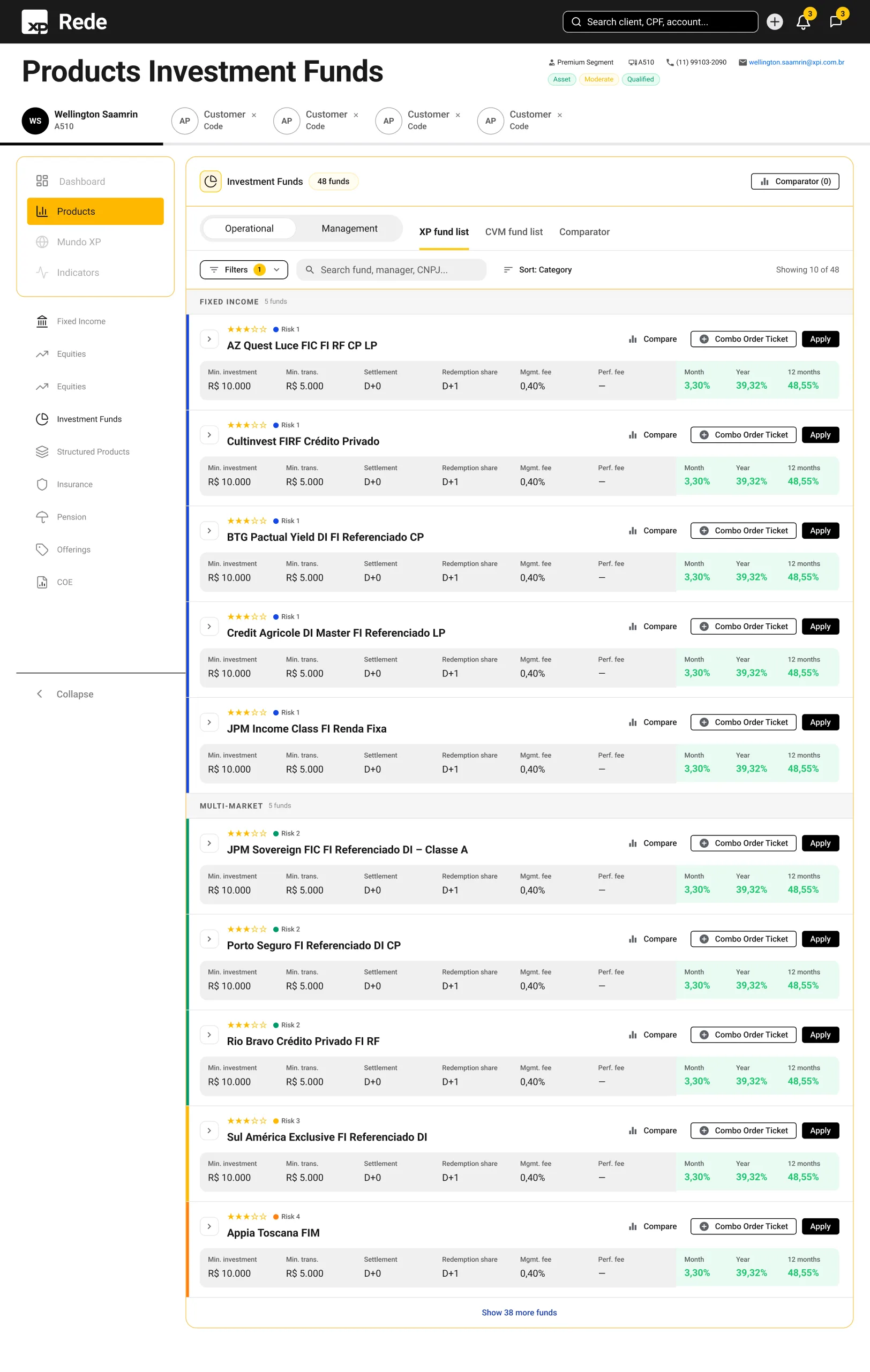
INVESTMENT FUNDS — OPERATIONAL VIEW
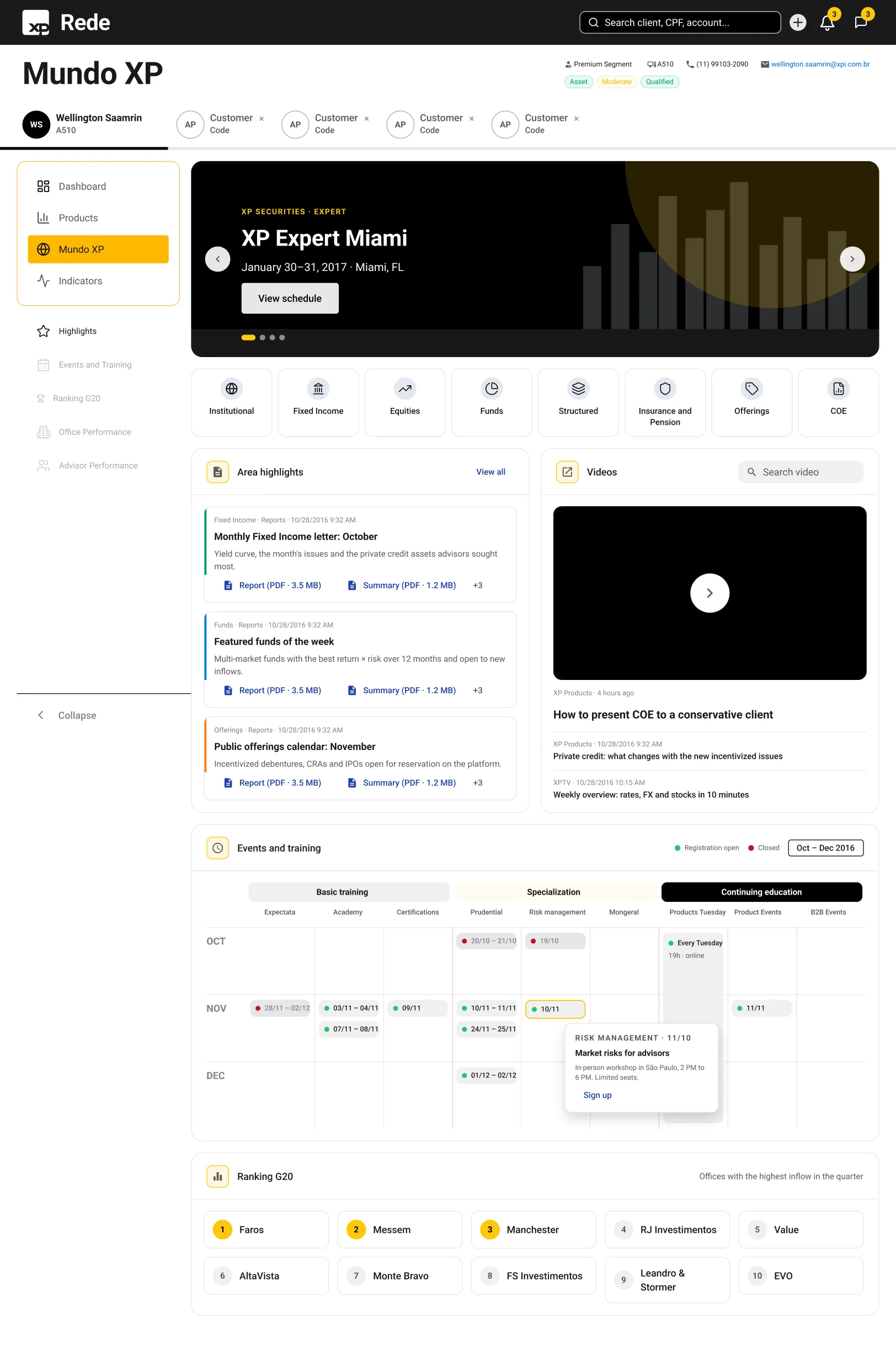
MUNDO XP — HOME
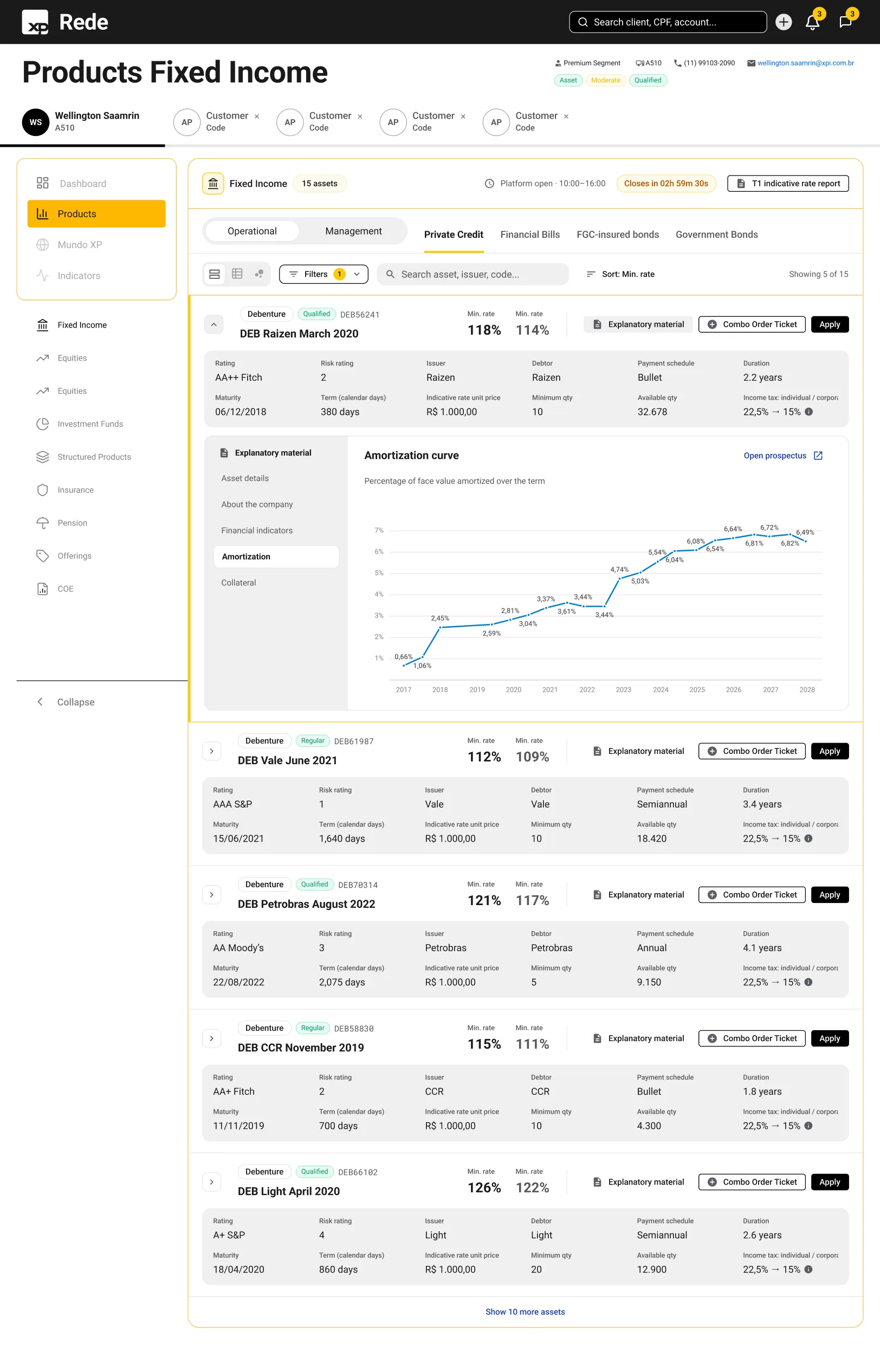
FIXED INCOME — EXPANDED CARD (AMORTIZATION)
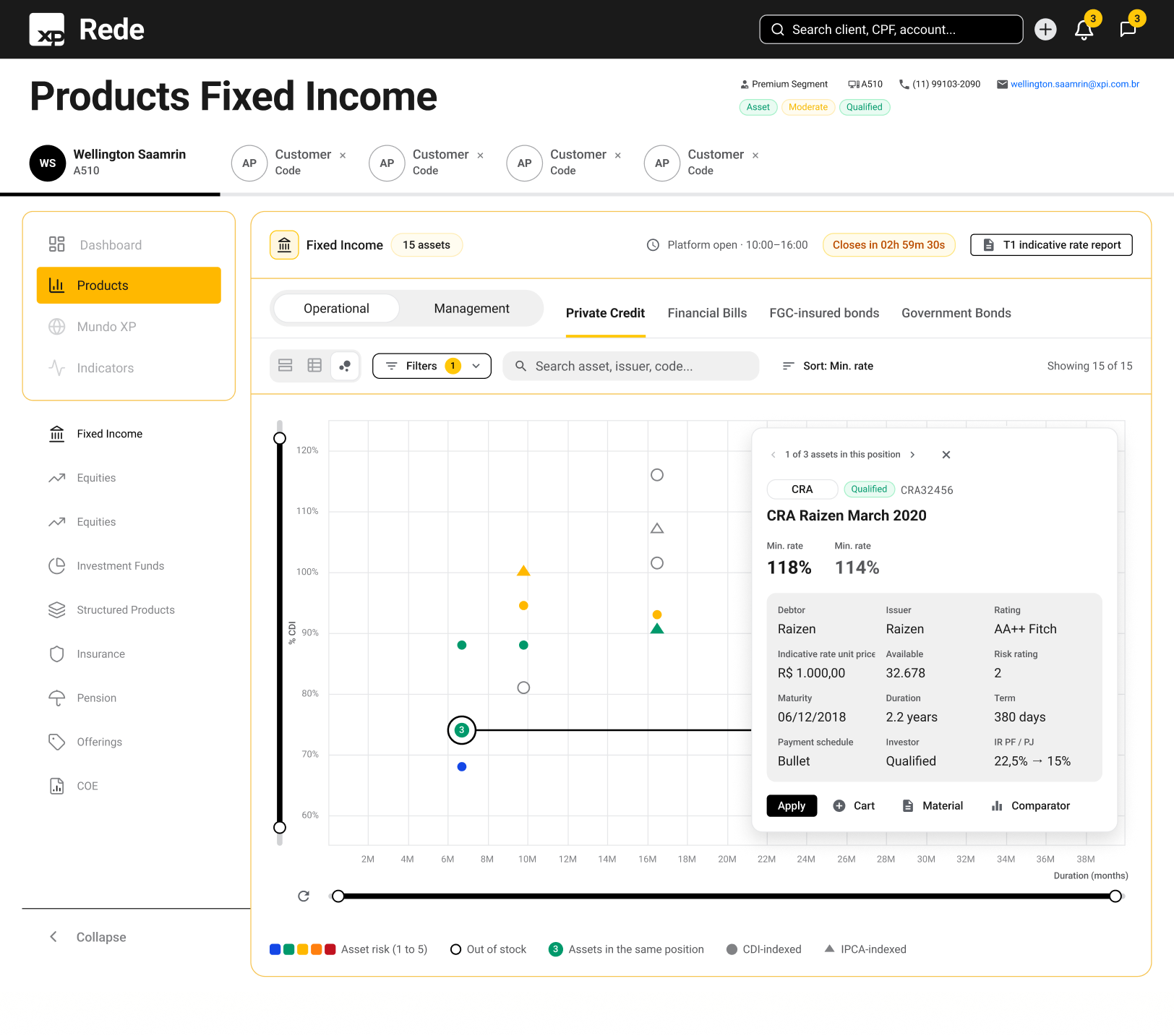
FIXED INCOME — CHART VIEW WITH A SELECTED ASSET
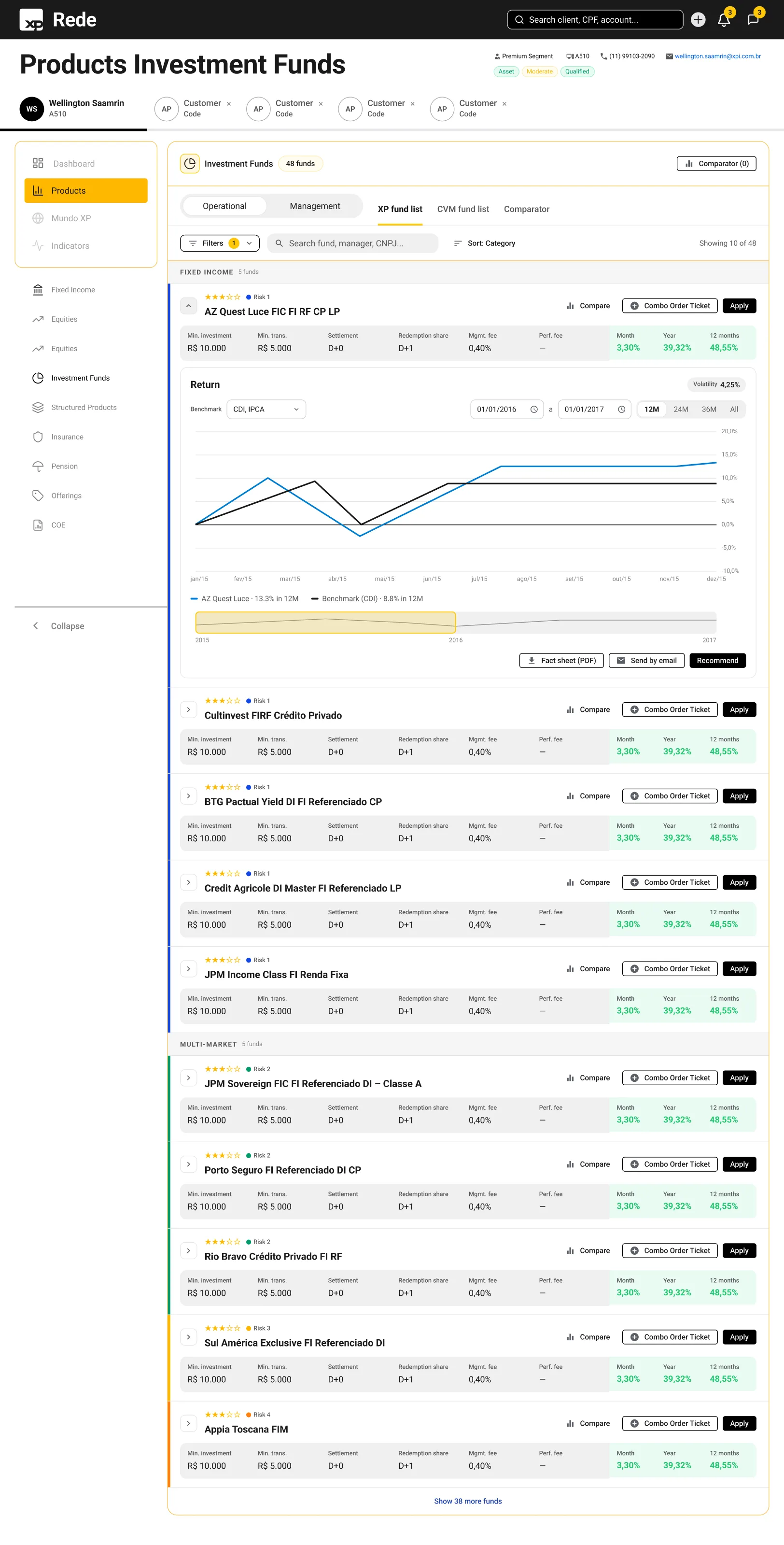
INVESTMENT FUNDS — EXPANDED CARD
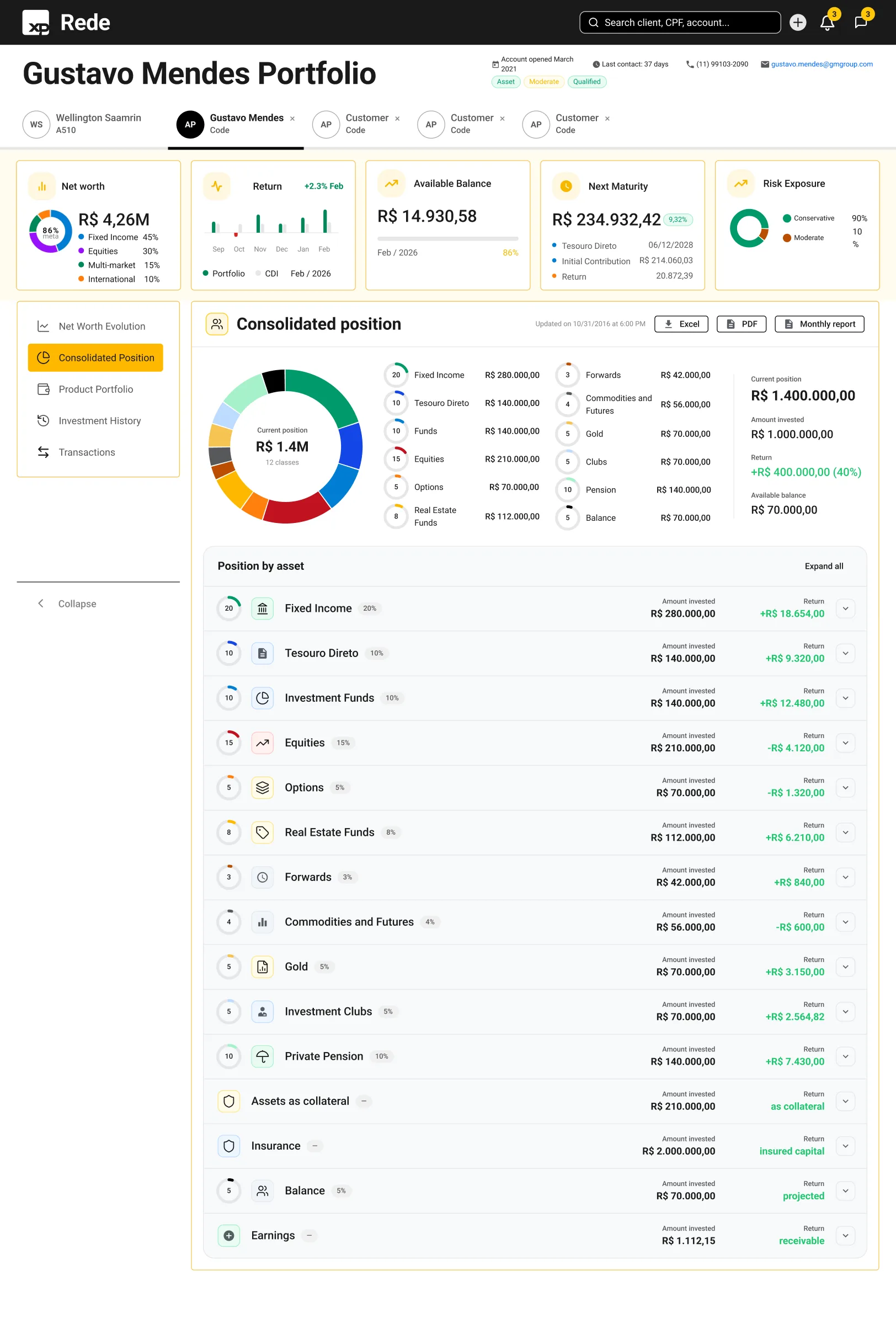
CLIENT PORTFOLIO — GUSTAVO MENDES
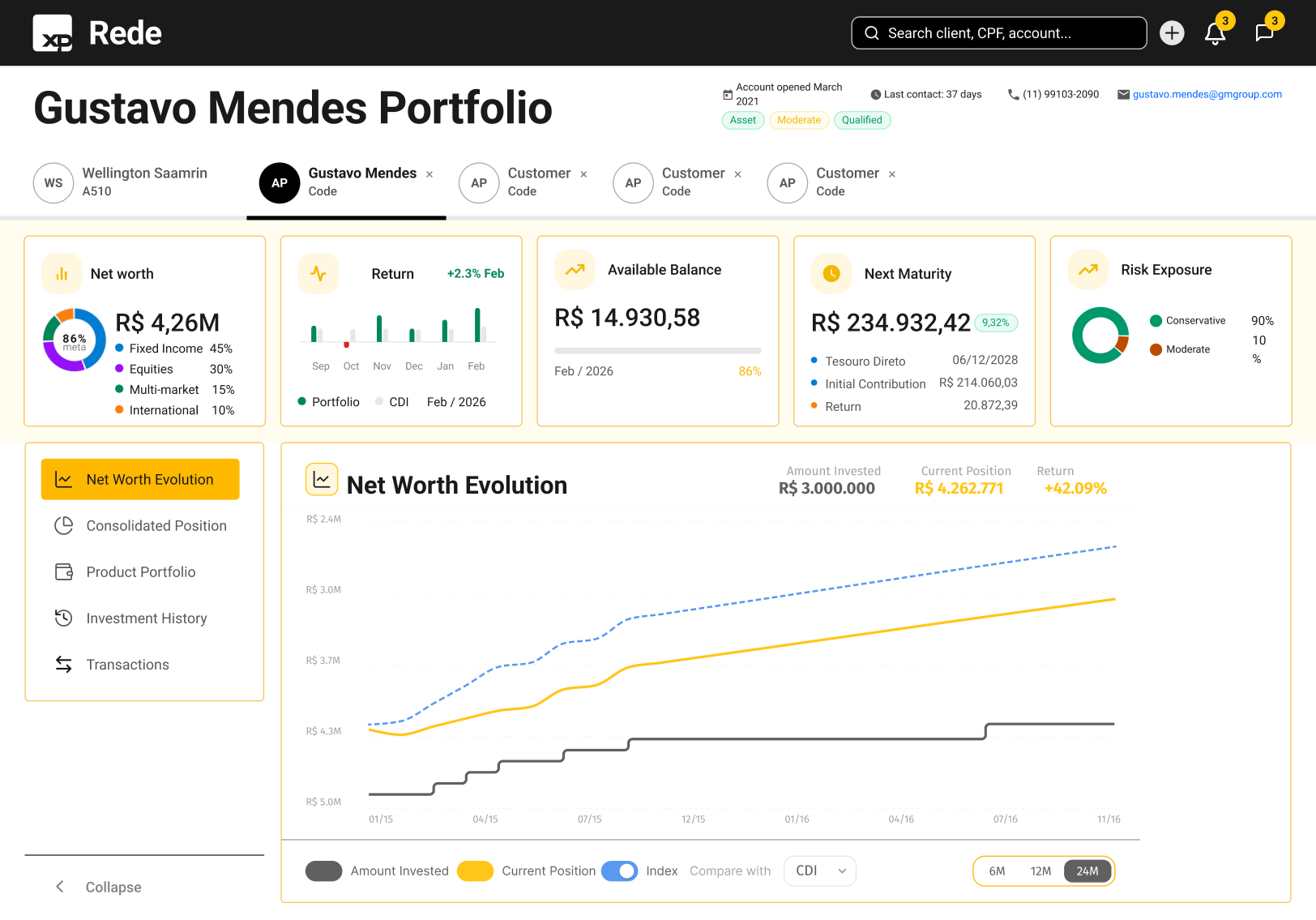
CLIENT PORTFOLIO — OVERVIEW
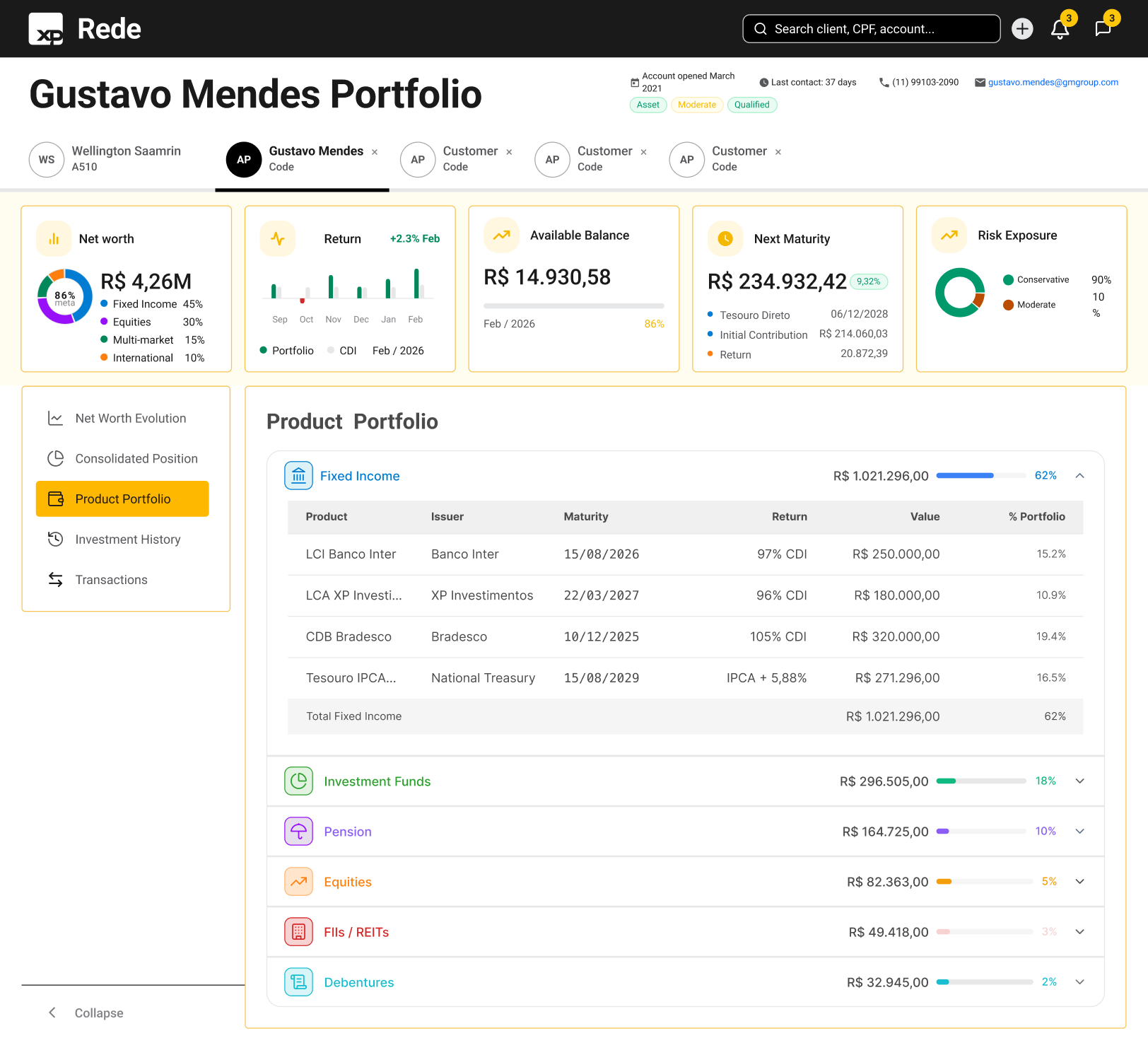
CLIENT PORTFOLIO — CONSOLIDATED POSITION
 1 / 4
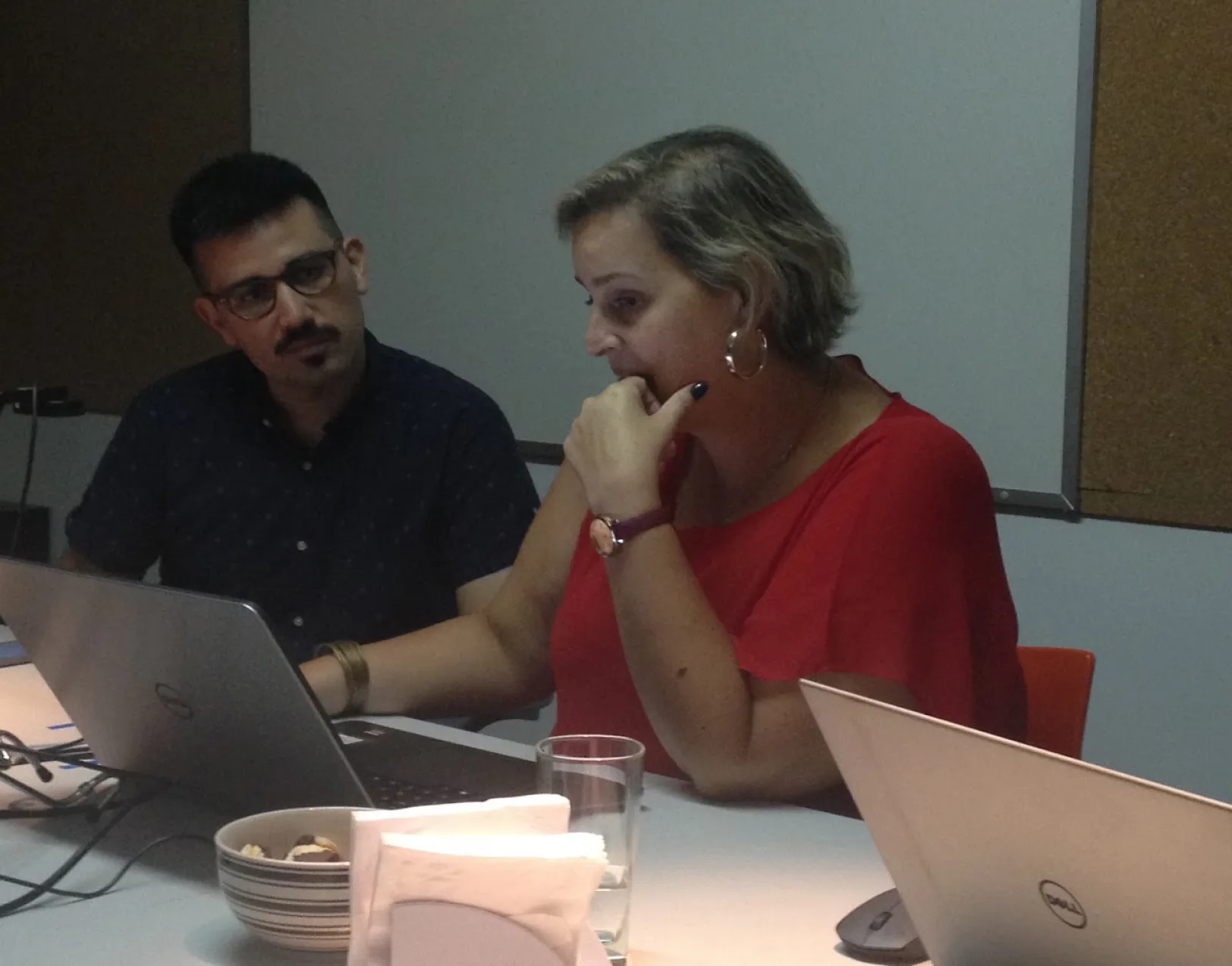
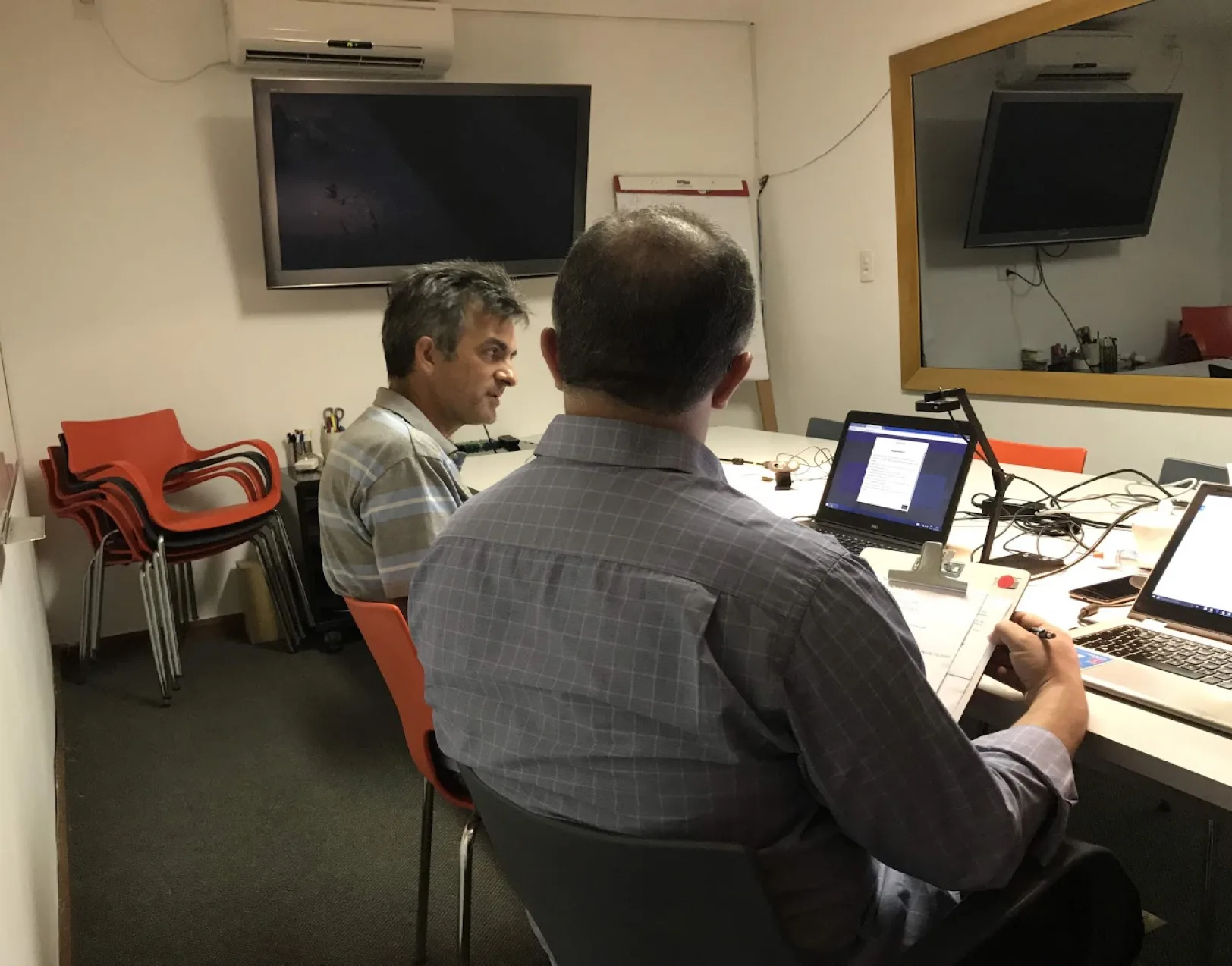
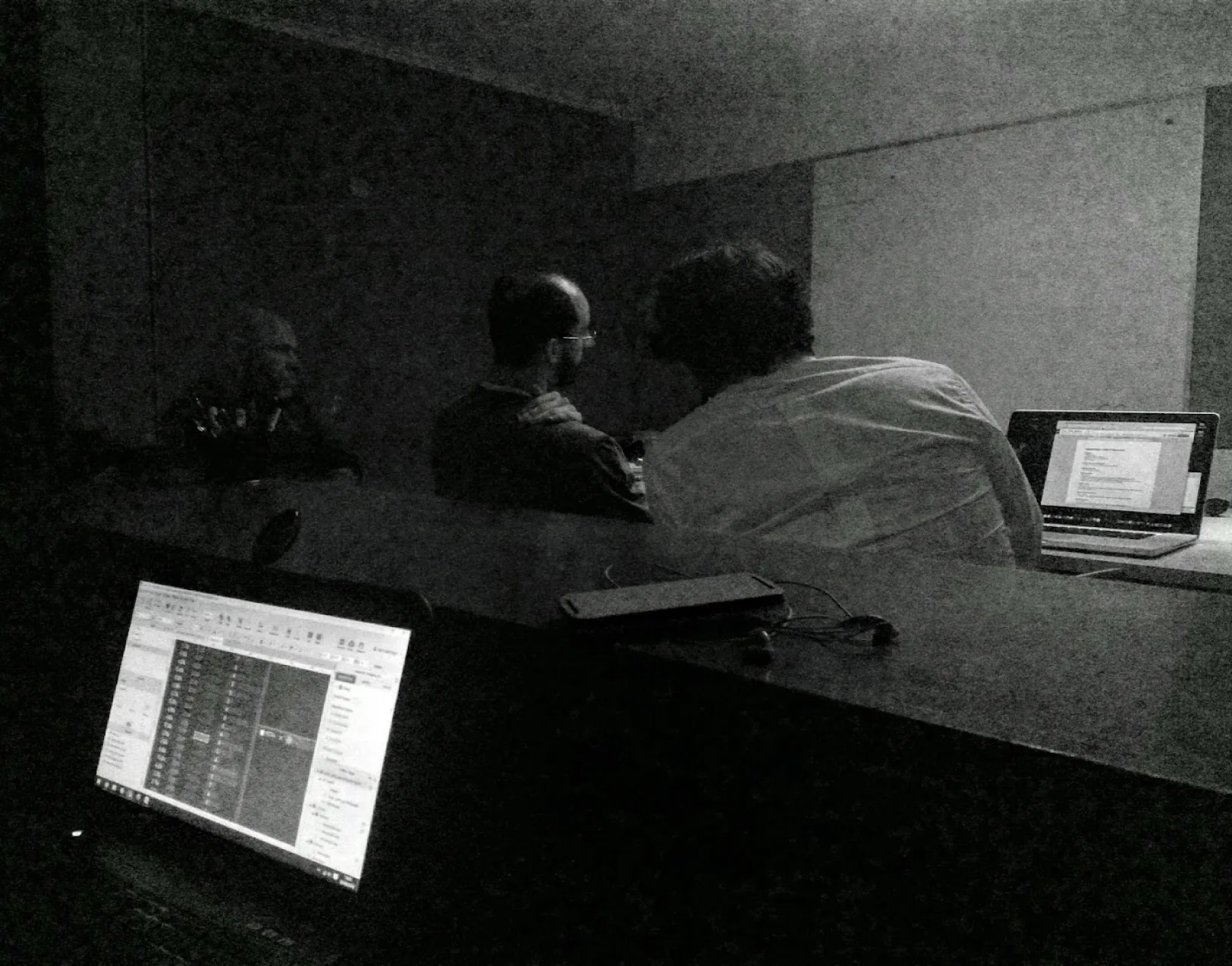
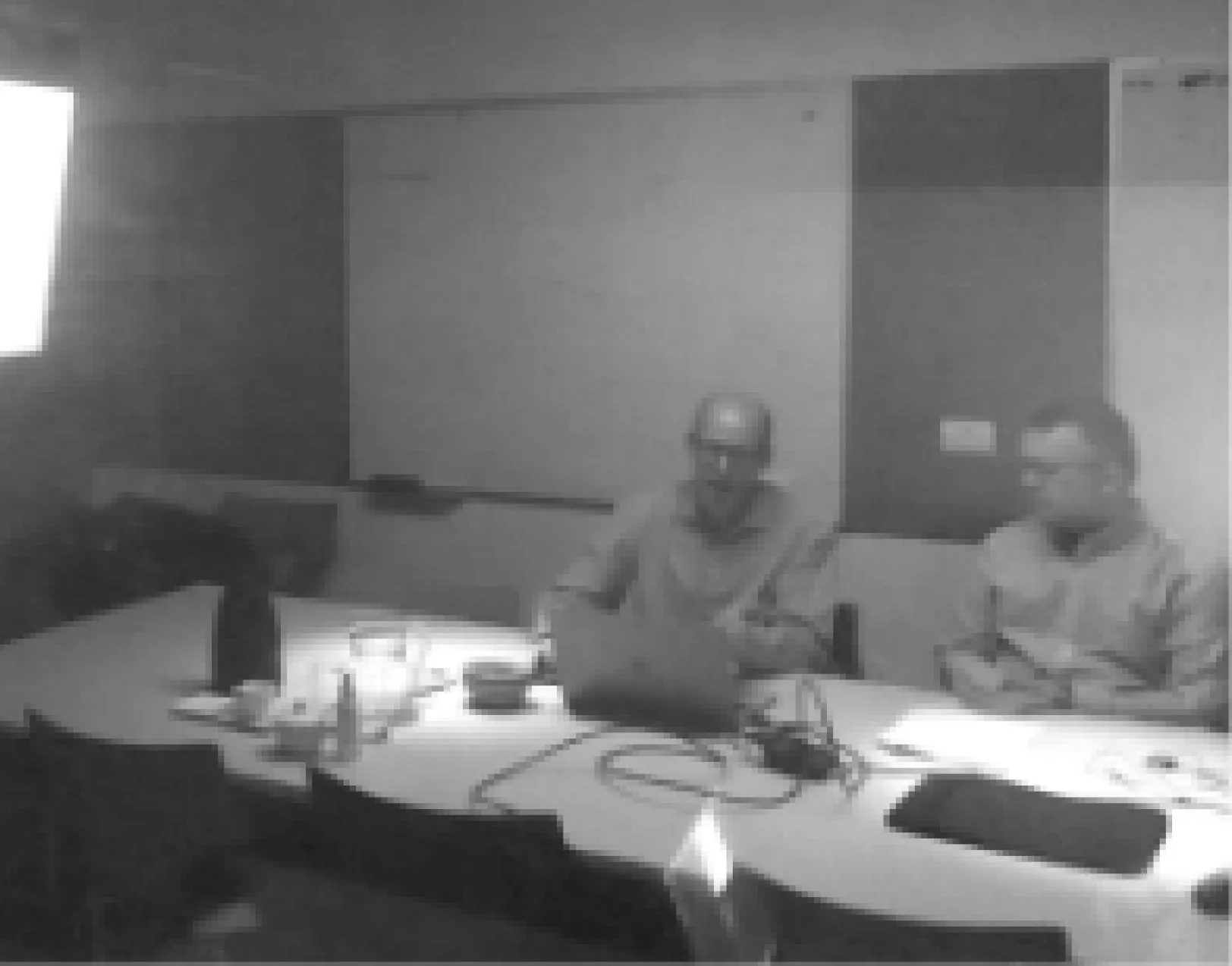
Usability testing with owners of partner-offices
I conducted usability tests with real users. I validated the platform's new navigation model. The new client tracking tools eliminated repetitive manual tasks. The platform passed the users' stress tests.
Introducing a new navigation model and client capital allocation revolutionized advisors' work experience. They now have the freedom to focus more on their service strategy, a significant shift from spending 50% of their day manually processing assets data.
Creating consolidated asset views in a single space was a design decision that immensely helped brokers in their work. This measure significantly improved the mental health of investment advisors.
The client didn't accept conversational interaction applied to investment applications. The engineering team estimated that these conversational models for investments were not technologically viable at the time. There was a lack of artificial intelligence models that are more accessible today.
“I like everything I see here. My workflow will improve a lot. Do you already know if there is an estimated date that we'll be able to work with this new platform? I am considering to set new key results taking into consideration these new tools.”
— Owner of Partner-office
"I like how the working experience improved here. My daily work will improve a lot as well. Do you already have an estimated date for us to start using this new platform?"
— Owner of Partner-office
Results
The new platform played a pivotal role in XP Investimentos' growth, enabling the establishment of strategic partnerships with new partner offices. In contrast, the old platform hindered the expansion of the partner network.
The new working platform allowed the network of partner offices to grow exponentially from 150 to 600 partners, a 300% increase.
The number of advisors has grown remarkably, from 3,000 to 10,000 in just 3 years, a 233% increase. Currently, 14,000 advisors are connected to XP's ecosystem, a 367% increase since the new platform went live in 2024.
This exponential growth is a testament to the platform's potential and its positive impact on the investment advisor community. XP is a pioneer in developing investment advisor careers in Brazil and has actively contributed to its growth and consolidation.
“I like everything I see here. My workflow will improve a lot.”
— PARTNER-OFFICE OWNER — USABILITY TESTING
Learning
On platforms for professional operators, reducing cognitive load in navigation has a direct impact on the business's ability to grow — not just on the speed of executing individual tasks.